Stop 2 / 7 · Servin's studio
From Camille Corot to Amédée Servin, by way of Théodule Ribot and Georges Serrier, a tradition founded on patient observation and tonal accuracy was handed down - a parallel modernity, overlooked by a historiography centred on Impressionism.
In front of the panel of this stop, scan the QR code: the painting reappears in the landscape. The experience needs the panel, it cannot be launched remotely.
Main work
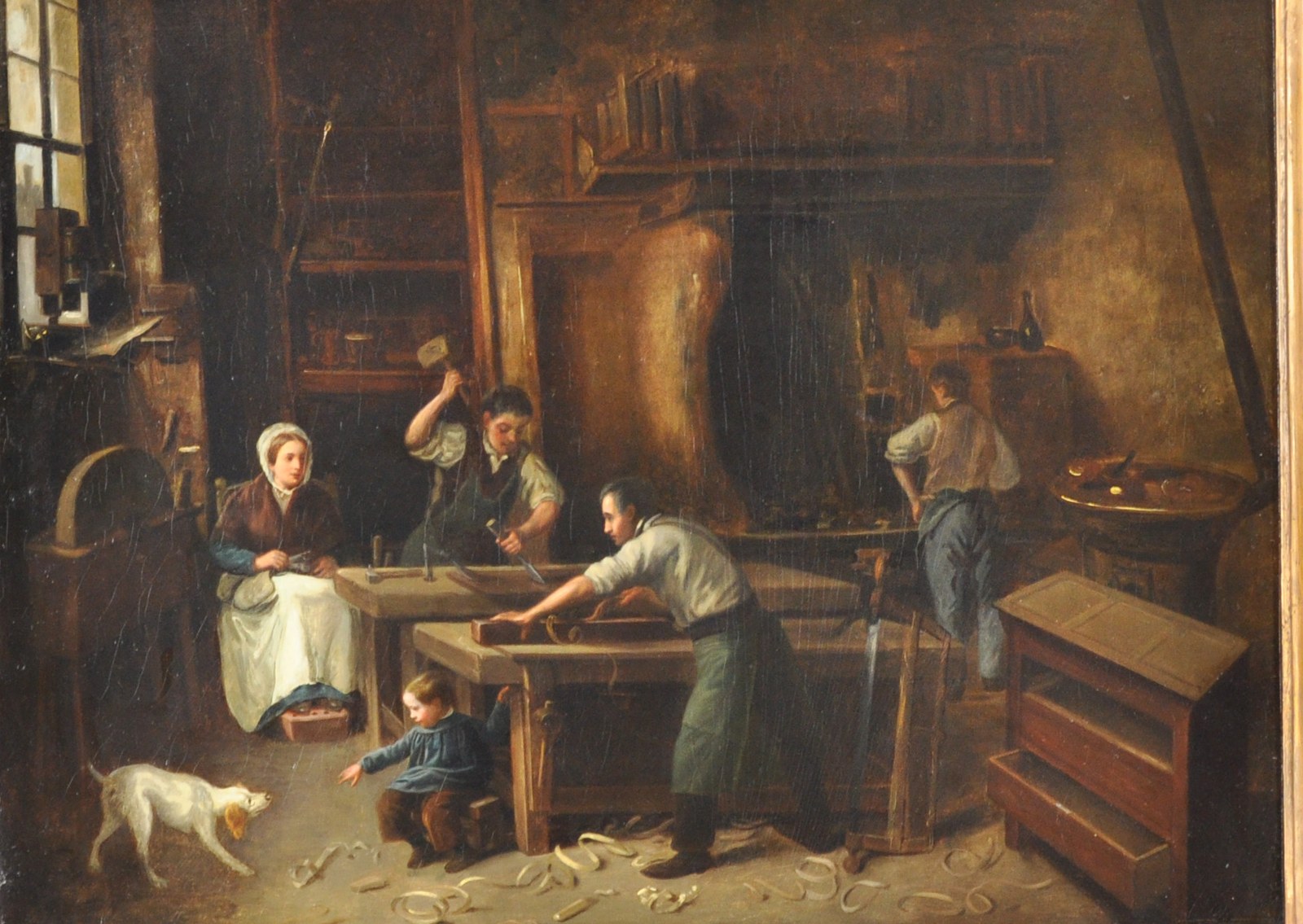
Amédée Servin (1829-1884) · Third quarter of the 19th century · Oil on canvas · 60 × 73 cm
Four adults gather around a solid wooden workbench in the warm half-light of a Brie workshop. The man in the white shirt raises his arm to adjust a piece; on the right, a craftsman contemplates the work in progress. A woman in a white bonnet watches from the left, a domestic presence reminding us that in the mid-19th century the workshop was not yet separate from family life. A child stares at the carpenters at work; near him, a white dog has lain down among the pale wood shavings.
Servin builds this scene with a rigorous geometry: the verticals of the planks, the horizontals of the bench, the diagonals of arms and tools organise the depth while keeping the figures within a tight plane. The palette stays within a register of deep browns, warm ochres and off-whites, applied in thick touches that let the very materiality of the paint show through. In the Dutch tradition of the workshop picture, Servin celebrates the dignity of manual labour at the very moment when industrialisation was beginning to undermine it.
Notice · Galerie de Crécy
More about the work Amédée Servin Before Impressionism - the lesson of the motif
Secondary work
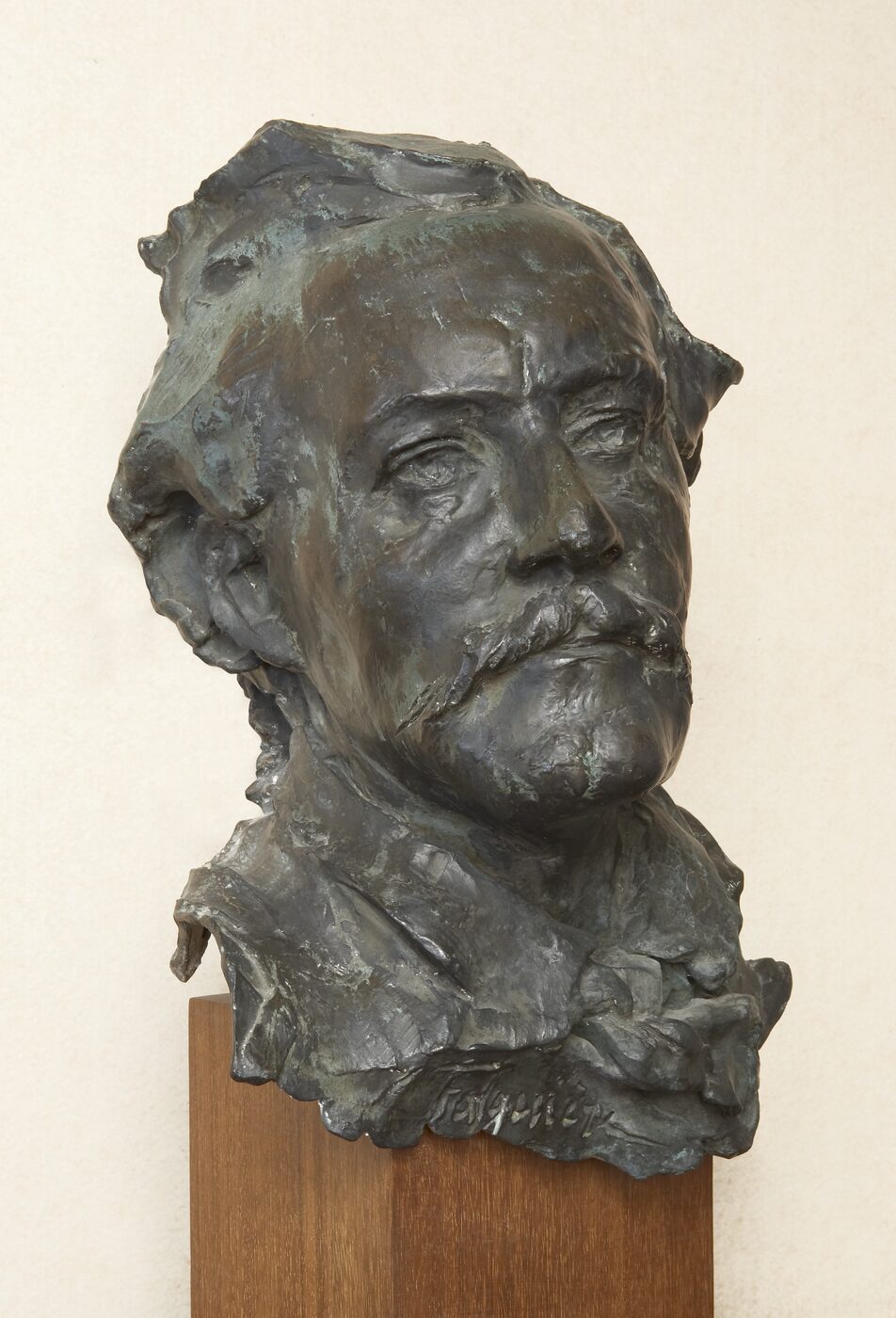
Alexandre Falguière (1831-1900) · 1887 · Bronze medallion · Commemorative monument, Villiers-sur-Morin
On 2 October 1887, three years after the death of Amédée Servin, a monument was raised in the centre of Villiers-sur-Morin. Erected by public subscription, this obelisk designed by the sculptor Legrain serves both as a cenotaph and as a public fountain. At its top, Alexandre Falguière placed a bronze medallion: the portrait of the man known as “the master of the Morin valley”, founder of the Cercle artistique in 1860.
This is not an idealised effigy in the codes of heroic statuary, but a face caught in the density of its physical presence. The bronze, with its verdigris patina, bears the marks of the weather: the work exists not in the abstraction of the museum but in the real duration of a monument exposed to the elements, subject to the same cycle of seasons as the landscapes Servin painted.
Notice · Galerie de Crécy
More about the work Alexandre Falguière Before Impressionism - the lesson of the motif
 ← Stop 1The Bridge at Villiers Stop 3 →Rue du Bas