Stop 1 / 7 · The Bridge at Villiers
The birth and erasure of an artists' colony active between 1860 and 1928, which never came to form a recognised "school". Founded by Amédée Servin, this Brie hub welcomed heterogeneous practices, from the tradition inherited from Corot to Cloisonnist experiments and on to the Expressionism of Yuzō Saeki.
In front of the panel of this stop, scan the QR code: the painting reappears in the landscape. The experience needs the panel, it cannot be launched remotely.
Main work
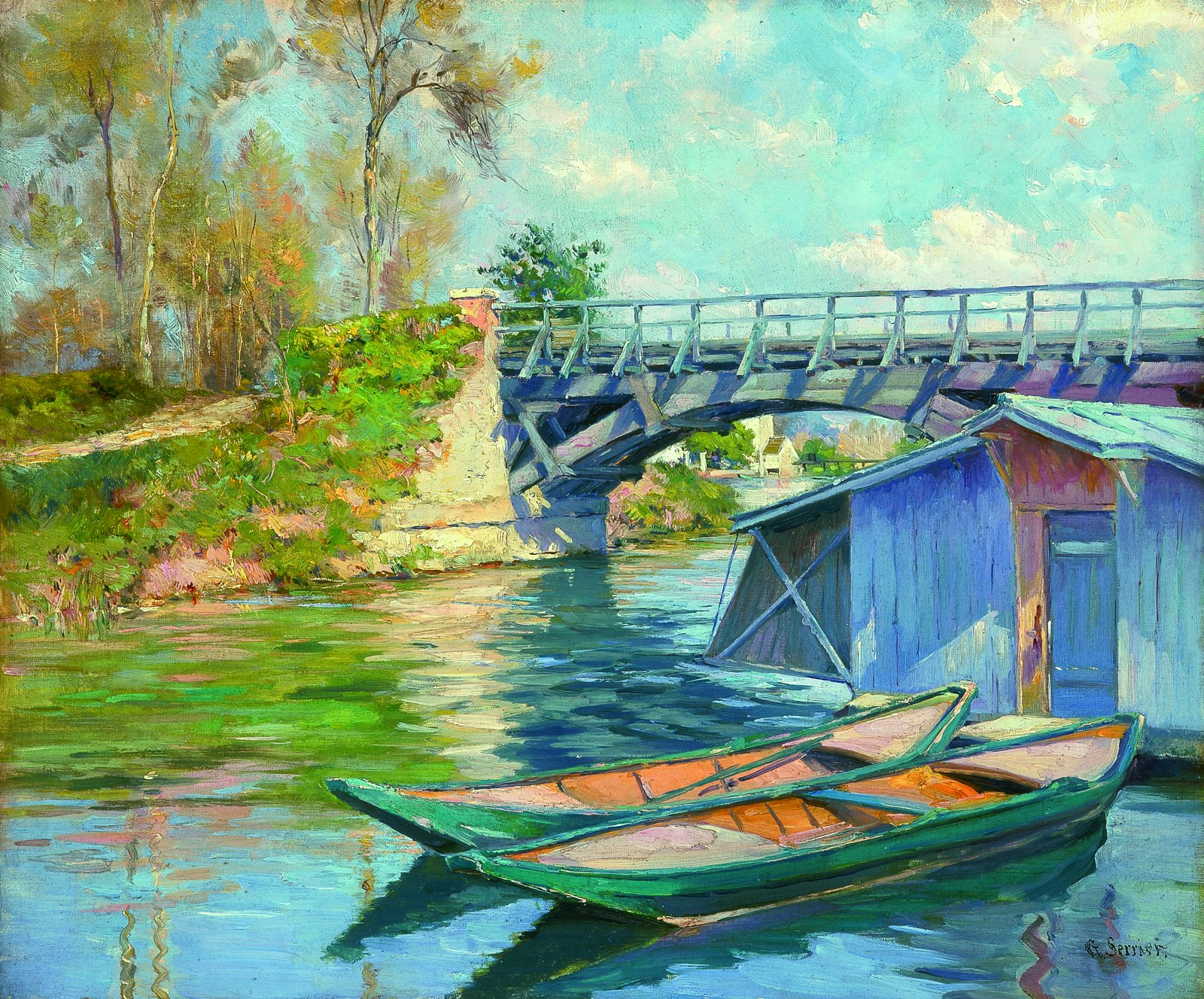
Georges Serrier (1852-1945) · 1888 · Oil on canvas · 54 × 45 cm
The year 1888 marked for Georges Serrier a moment of quiet consecration: a few months after showing Evening at Villiers-sur-Morin (Le soir à Villiers-sur-Morin) at the Salon des Artistes Français, the painter from Lorraine, trained in the studios of Gagliardini and Oudry, once again set up his easel on the banks of the Grand Morin. In this canvas of modest dimensions, he fixes one of the most emblematic motifs of the Brie landscape: the wooden bridge crossing the composition on the diagonal, the blue washhouse moored to the bank, the flat-bottomed boats tied up in the foreground.
The spatial construction reveals an assured command of the compositional balances inherited from the tradition of Corot. The perspective, governed by the oblique line of the bridge receding towards the left of the picture, organises the depth according to a classical scheme, but the choice of a tight framing and a slightly raised viewpoint creates a contemplative intimacy that brings the work close to the Impressionist experiments of the time. Like Monet or Sisley, Serrier seeks to capture the luminous instant in its atmospheric truth, but he does so while retaining the structural solidity that anchors sensation in duration.
It is in this tension between permanence and transience that the symbolic charge of the work resides. The washhouse, a place of women’s labour, a space where gestures and words were passed on, embodies that part of everyday life in which the social bond is formed in its most concrete dimension. To paint it in 1888, when urban modernisation was beginning to transform rural ways of life, was to raise to the dignity of a pictorial subject what remained, for contemporaries, in the order of the prosaic and self-evident.
Having arrived at Villiers-sur-Morin in the wake of Amédée Servin, Georges Serrier embodies that generation of artists who, without seeking to revolutionise the language of painting, ensured the transmission of a French landscape sensibility attached to the patient observation of the real. What Serrier shows us is not a relic but a persistence: that of a way of inhabiting the landscape, of inscribing human labour in it without disfiguring it.
Marie Gawlikowski & Grégory Mazet, Galerie de Crécy
More about the work Georges Serrier Villiers-sur-Morin, a forgotten colony
Secondary work
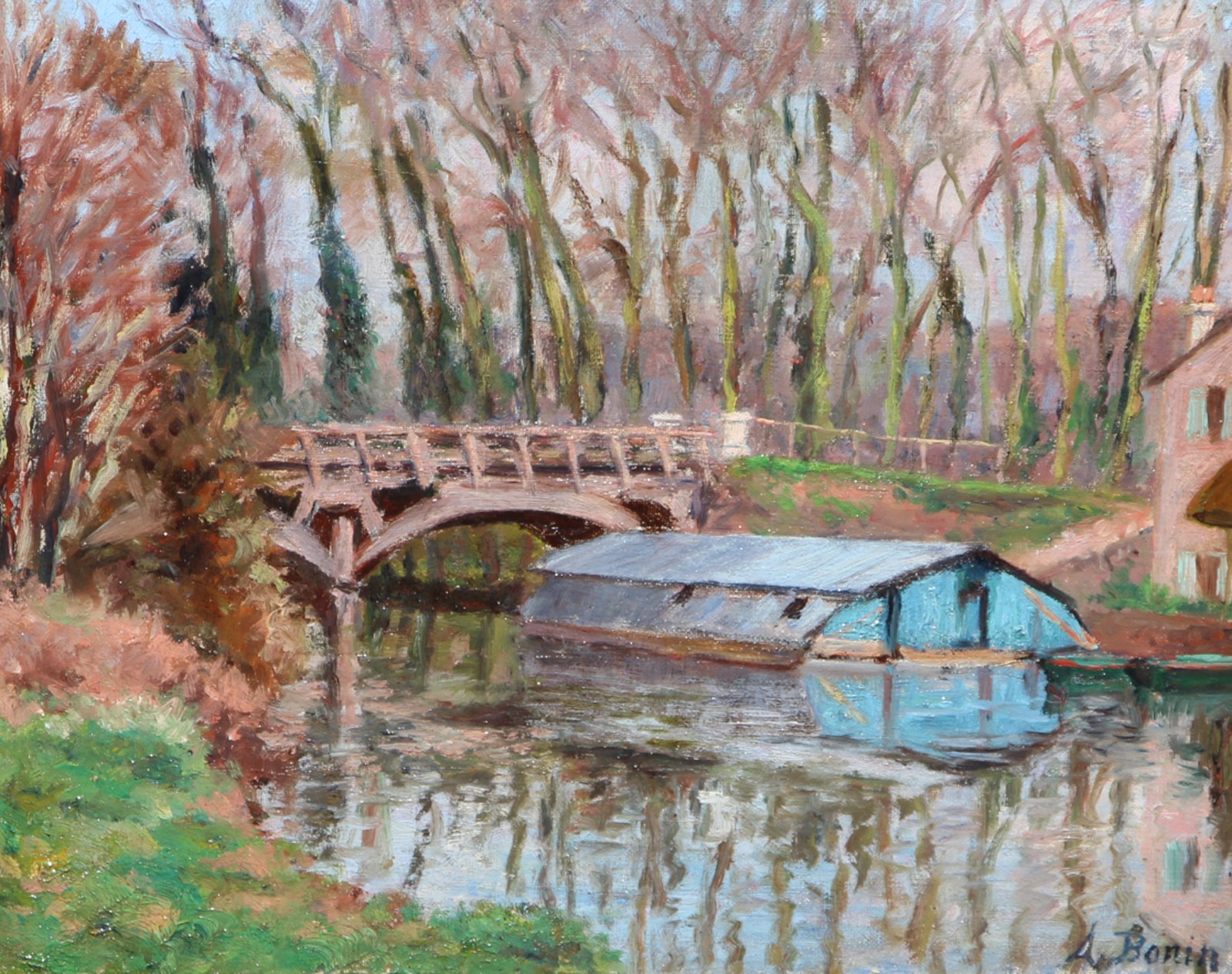
Alexandre Bonin (1876-1943) · First half of the 20th century · Oil on canvas · 38 × 46 cm
Forty years after Georges Serrier fixed on canvas the wooden bridge spanning the Grand Morin, Alexandre Bonin returned to the same motif, but in a winter light that radically transforms its meaning. The composition takes up the scheme established in 1888: the bridge on the diagonal, the washhouse moored to the bank, the poplars lining the shore. But this is no longer the summer landscape vibrant with greenery; it is a landscape of latency in which nature seems to be holding its breath.
The brushwork, applied in small, tightly packed commas according to the divisionist technique inherited from the Impressionists, gives the surface a characteristic optical vibration: the reflections, the bare branches and the handrail of the bridge dissolve into a mosaic of coloured touches that only come together again at a distance. The palette conveys the particular light of winter days in the Île-de-France, made of faded pinks and muted blues.
It is in the choice of season that the symbolic charge of the work lies. The bare trees introduce a melancholy dimension, reinforced by the absence of any human figure. The washhouse exists, the bridge remains, but no one inhabits this scene. In the 1920s, washhouses were gradually disappearing, replaced by running water; wooden bridges were giving way to concrete structures. What Bonin fixes is perhaps one of the last moments when this landscape still existed as it was.
That a son-in-law of Camille Pissarro should come and set up his easel at Villiers-sur-Morin is no coincidence: by marrying Jeanne Pissarro, known as Cocotte, in 1920, Alexandre Bonin inherited a pictorial lineage whose principles he absorbed. The wooden bridge no longer exists today, the washhouse has vanished, the poplars have been felled. But the canvas remains, the last trace of a landscape that was once inhabited by painters.
Marie Gawlikowski & Grégory Mazet, Galerie de Crécy
More about the work Alexandre Bonin Villiers-sur-Morin, a forgotten colony