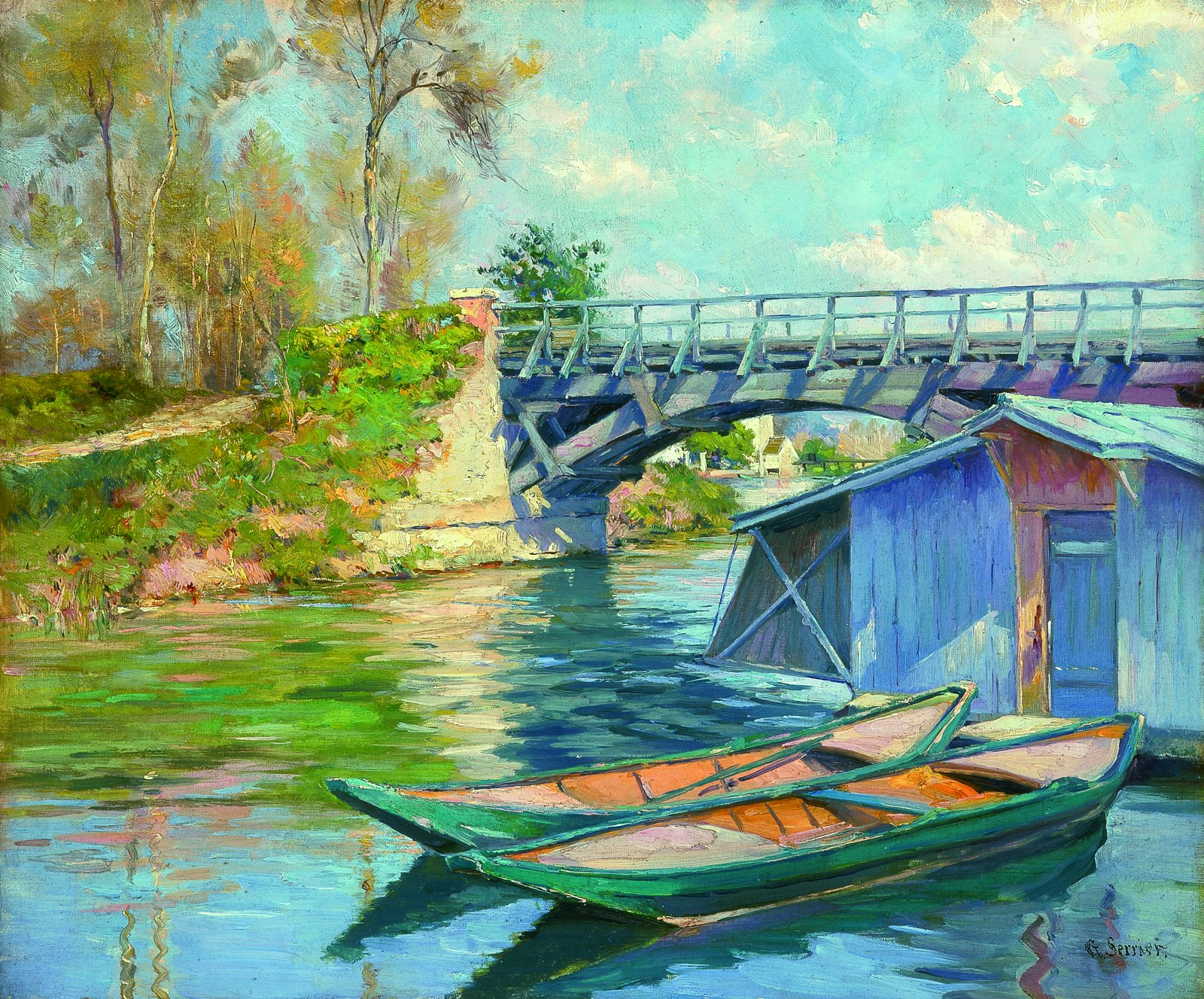
Georges Serrier (1852-1945) · 1888 · Oil on canvas · 54 × 45 cm · Original title : Le pont de Villiers avec le lavoir
The year 1888 marked for Georges Serrier a moment of quiet consecration: a few months after showing Evening at Villiers-sur-Morin (Le soir à Villiers-sur-Morin) at the Salon des Artistes Français, the painter from Lorraine, trained in the studios of Gagliardini and Oudry, once again set up his easel on the banks of the Grand Morin. In this canvas of modest dimensions, he fixes one of the most emblematic motifs of the Brie landscape: the wooden bridge crossing the composition on the diagonal, the blue washhouse moored to the bank, the flat-bottomed boats tied up in the foreground.
The spatial construction reveals an assured command of the compositional balances inherited from the tradition of Corot. The perspective, governed by the oblique line of the bridge receding towards the left of the picture, organises the depth according to a classical scheme, but the choice of a tight framing and a slightly raised viewpoint creates a contemplative intimacy that brings the work close to the Impressionist experiments of the time. Like Monet or Sisley, Serrier seeks to capture the luminous instant in its atmospheric truth, but he does so while retaining the structural solidity that anchors sensation in duration.
It is in this tension between permanence and transience that the symbolic charge of the work resides. The washhouse, a place of women’s labour, a space where gestures and words were passed on, embodies that part of everyday life in which the social bond is formed in its most concrete dimension. To paint it in 1888, when urban modernisation was beginning to transform rural ways of life, was to raise to the dignity of a pictorial subject what remained, for contemporaries, in the order of the prosaic and self-evident.
Having arrived at Villiers-sur-Morin in the wake of Amédée Servin, Georges Serrier embodies that generation of artists who, without seeking to revolutionise the language of painting, ensured the transmission of a French landscape sensibility attached to the patient observation of the real. What Serrier shows us is not a relic but a persistence: that of a way of inhabiting the landscape, of inscribing human labour in it without disfiguring it.
Marie Gawlikowski & Grégory Mazet, Galerie de Crécy