
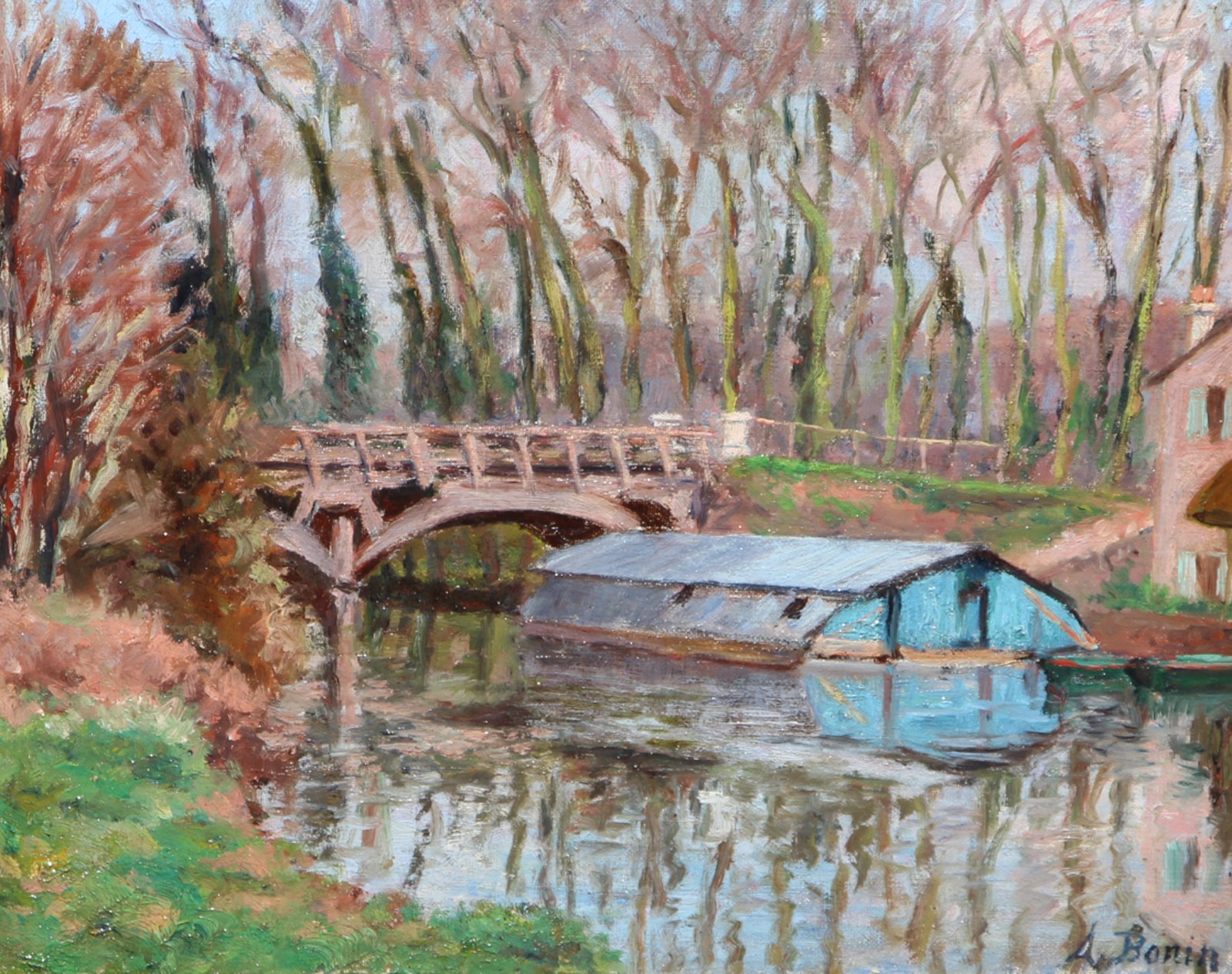
Alexandre Bonin (1876-1943) · First half of the 20th century · Oil on canvas · 38 × 46 cm · Original title : Le bateau lavoir à Villiers-sur-Morin
Forty years after Georges Serrier fixed on canvas the wooden bridge spanning the Grand Morin, Alexandre Bonin returned to the same motif, but in a winter light that radically transforms its meaning. The composition takes up the scheme established in 1888: the bridge on the diagonal, the washhouse moored to the bank, the poplars lining the shore. But this is no longer the summer landscape vibrant with greenery; it is a landscape of latency in which nature seems to be holding its breath.
The brushwork, applied in small, tightly packed commas according to the divisionist technique inherited from the Impressionists, gives the surface a characteristic optical vibration: the reflections, the bare branches and the handrail of the bridge dissolve into a mosaic of coloured touches that only come together again at a distance. The palette conveys the particular light of winter days in the Île-de-France, made of faded pinks and muted blues.
It is in the choice of season that the symbolic charge of the work lies. The bare trees introduce a melancholy dimension, reinforced by the absence of any human figure. The washhouse exists, the bridge remains, but no one inhabits this scene. In the 1920s, washhouses were gradually disappearing, replaced by running water; wooden bridges were giving way to concrete structures. What Bonin fixes is perhaps one of the last moments when this landscape still existed as it was.
That a son-in-law of Camille Pissarro should come and set up his easel at Villiers-sur-Morin is no coincidence: by marrying Jeanne Pissarro, known as Cocotte, in 1920, Alexandre Bonin inherited a pictorial lineage whose principles he absorbed. The wooden bridge no longer exists today, the washhouse has vanished, the poplars have been felled. But the canvas remains, the last trace of a landscape that was once inhabited by painters.
Marie Gawlikowski & Grégory Mazet, Galerie de Crécy