The painters
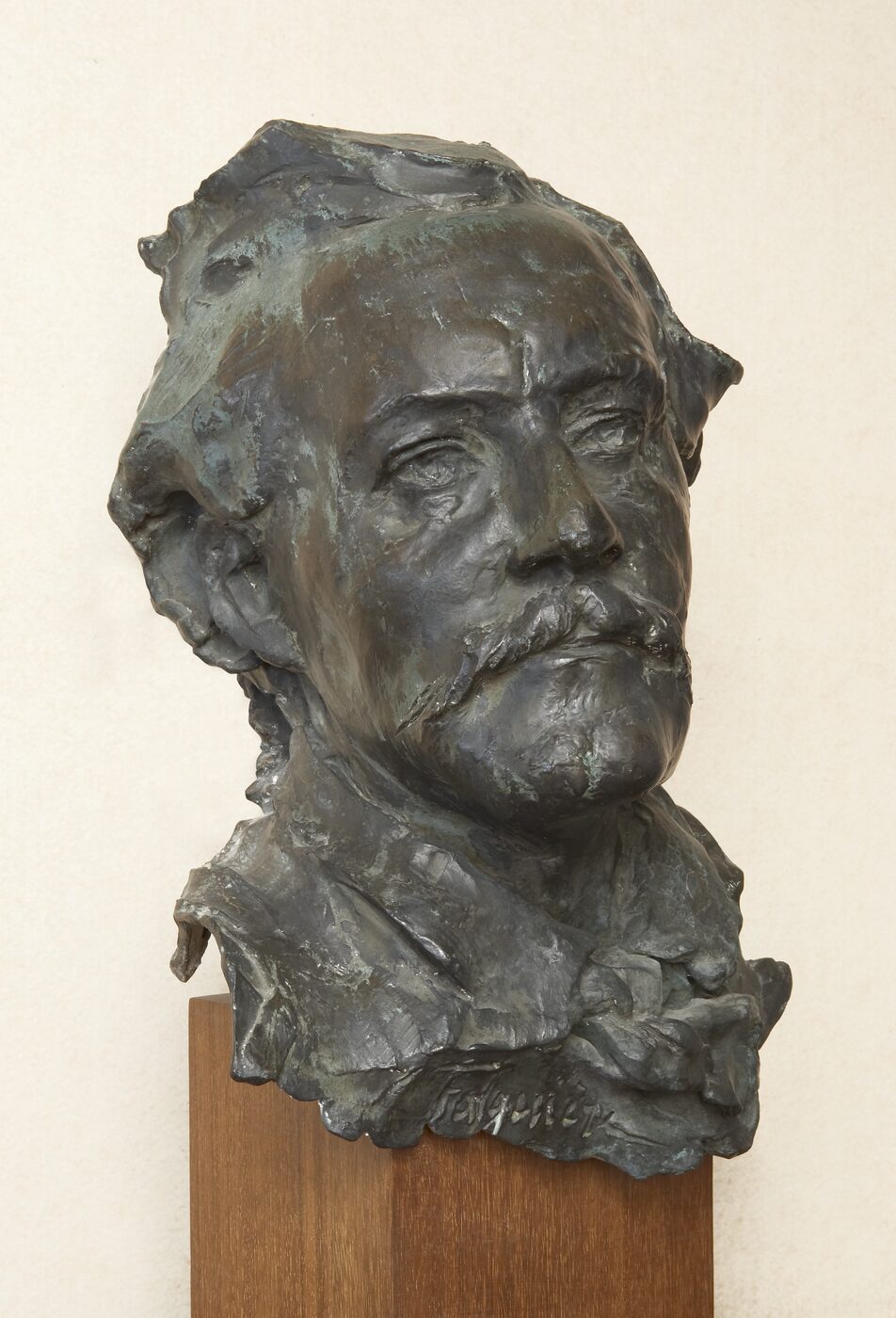
Alexandre Falguière, Portrait of Amédée Servin
Born in Toulouse on 7 September 1831, Jean-Alexandre Joseph Falguière won the Grand Prix de Rome in 1859 and stayed at the Villa Medici until 1865. His Tarcisius, Christian Martyr (Tarcisius, martyr chrétien), shown at the Salon of 1867, immediately earned him a national reputation. The career that followed was that of an acknowledged master: professor at the École des Beaux-Arts in Paris, member of the Institut, Commander of the Légion d’honneur. His monuments punctuate the public spaces of the Republic, statues, busts and allegories, from the portrait of Victor Hugo to the Diana the Huntress (Diane chasseresse) in the Musée d’Orsay.
It was to this sculptor, at the height of his official recognition, that the friends and admirers of Amédée Servin, founder of the Cercle artistique, who had died three years earlier, entrusted the medallion of the monument raised to his memory by subscription and inaugurated on 2 October 1887. The choice was no trivial matter: it speaks of the esteem in which the circle held its founder, and of the quality of the relations the village colony maintained with the most respected artistic circles in Paris. In a Brie village of a few hundred inhabitants, a painter’s monument thus bore the signature of one of the official sculptors of the Republic.
Falguière died in Paris on 19 April 1900. The medallion of Servin he left at Villiers-sur-Morin is much more than a local commemoration: it is the recognition, by the institution, that this territory had sheltered something genuinely important in the history of French art, and that this something deserved to be cast in bronze.
These notes draw on a combination of institutional, documentary and local sources: the artist directory of the Musée d’Orsay; the Centre national des arts plastiques (CNAP); the National Museum of Modern Art, Tokyo (MOMAT); Bénézit, Dictionnaire critique et documentaire des peintres, sculpteurs, dessinateurs et graveurs (Gründ); art market databases (Artprice, Drouot); the catalogues of the Salon des Artistes français and the Salon d’automne; the Satet-Menon collection relating to the painters of the Grand Morin valley; local sources relating to the Vallée des peintres (the commune of Villiers-sur-Morin, Coulommiers Pays de Brie Tourisme); the Museum of Modern Art, New York (Madame Lili Grenier, portrait by Toulouse-Lautrec, 1888); the Nakanoshima Museum of Art, Osaka (work by Yuzō Saeki).