Stop 3 / 7 · Rue du Bas
With the invention of paint tubes, artists broke free from the confines of the studio. Bridges, washhouses, lanes: they captured familiar motifs while rendering the changing light, turning the landscape into an inhabited territory.
In front of the panel of this stop, scan the QR code: the painting reappears in the landscape. The experience needs the panel, it cannot be launched remotely.
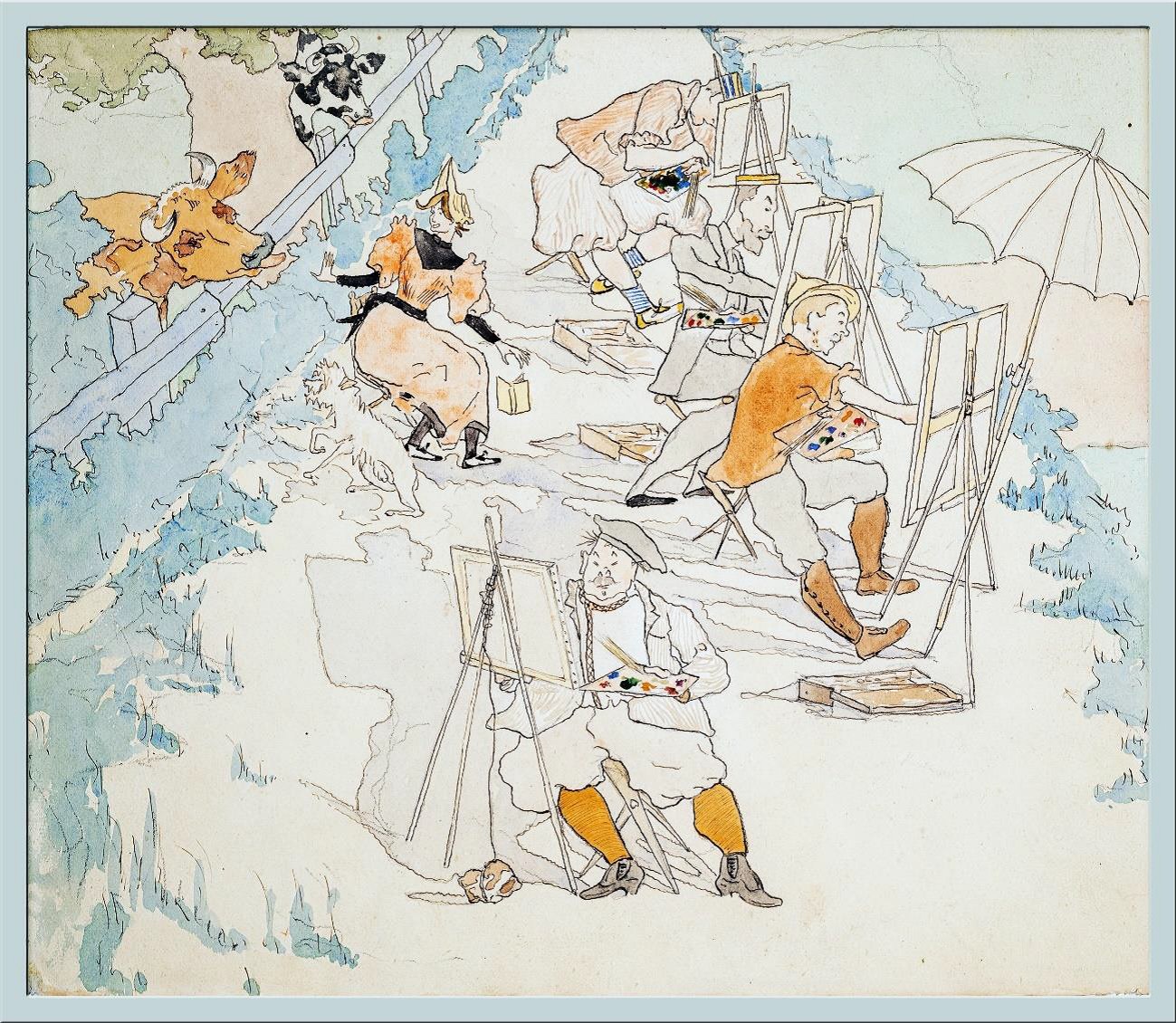
Main work
François Gauzi · Late 19th century · Watercolour over pen and ink · 31.5 × 36 cm
On a country path in the Brie, an unlikely gathering has assembled to paint from the motif: a black-and-white bull holds a brush before his easel, an ochre sheep wields its palette with diligence, while other painters, fully human, busy themselves beneath a white parasol. François Gauzi turns the plein-air session, that sacred ritual of pictorial modernity, into a burlesque scene in which the boundary between the artist and his usual model collapses.
The black ink line, nervous and spontaneous, outlines the forms without confining them, while the watercolour lays down its transparent washes of sky blue, tender green and golden ochre. Beneath the humour surfaces a lucid reflection on the repetition of motifs and poses in the plein-air painting of the Brie, and an affectionate look at a community that made the landscape a shared territory.
Notice · Galerie de Crécy
More about the work Painting outdoors - the emancipation of the easel
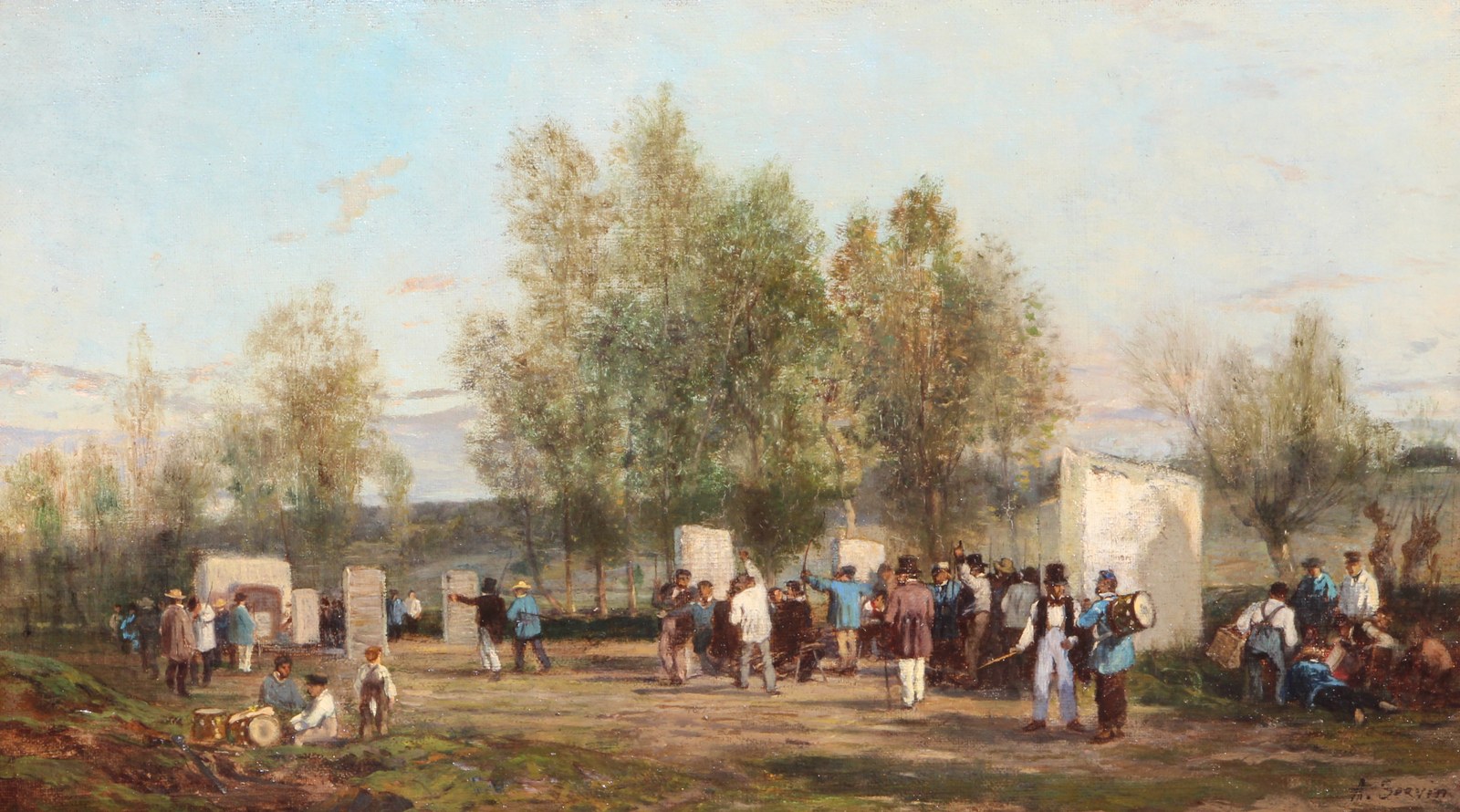
Secondary work
Amédée Servin (1829-1884) · Third quarter of the 19th century · Oil on canvas · 27 × 46 cm
The scene takes place in the open air, in that indeterminate space between the village and the fields of which Servin was so fond. In the centre, two white targets mounted on wooden frames mark out the competition ground. Around them is arranged a whole village gathering whose layout reflects the social hierarchy: on the left, a compact group of archers in dark clothes, some wearing top hats; on the right, near an inn, a more mixed crowd of spectators, women in white bonnets, children, men in working smocks.
The framing is wide, panoramic, as if Servin wished to take in at a single glance all the village sociability concentrated in this moment. The handling remains faithful to the realist manner the painter adopted from the 1860s onwards: a painting of social reality, attentive to the gestures, roles and collective rites that structure rural life, with the Brie territory treated not as mere scenery but as lived space.
Notice · Galerie de Crécy
More about the work Amédée Servin Painting outdoors - the emancipation of the easel
 ← Stop 2Servin's studio Stop 4 →The Cercle artistique