Stop 4 / 7 · The Cercle artistique
A hub where Servin, Serrier, Grenier, Anquetin and Saeki rubbed shoulders across contrasting practices, from studio realism to Expressionism. Its stylistic diversity and the absence of a charismatic leader explain its historical invisibility.
In front of the panel of this stop, scan the QR code: the painting reappears in the landscape. The experience needs the panel, it cannot be launched remotely.
Main work
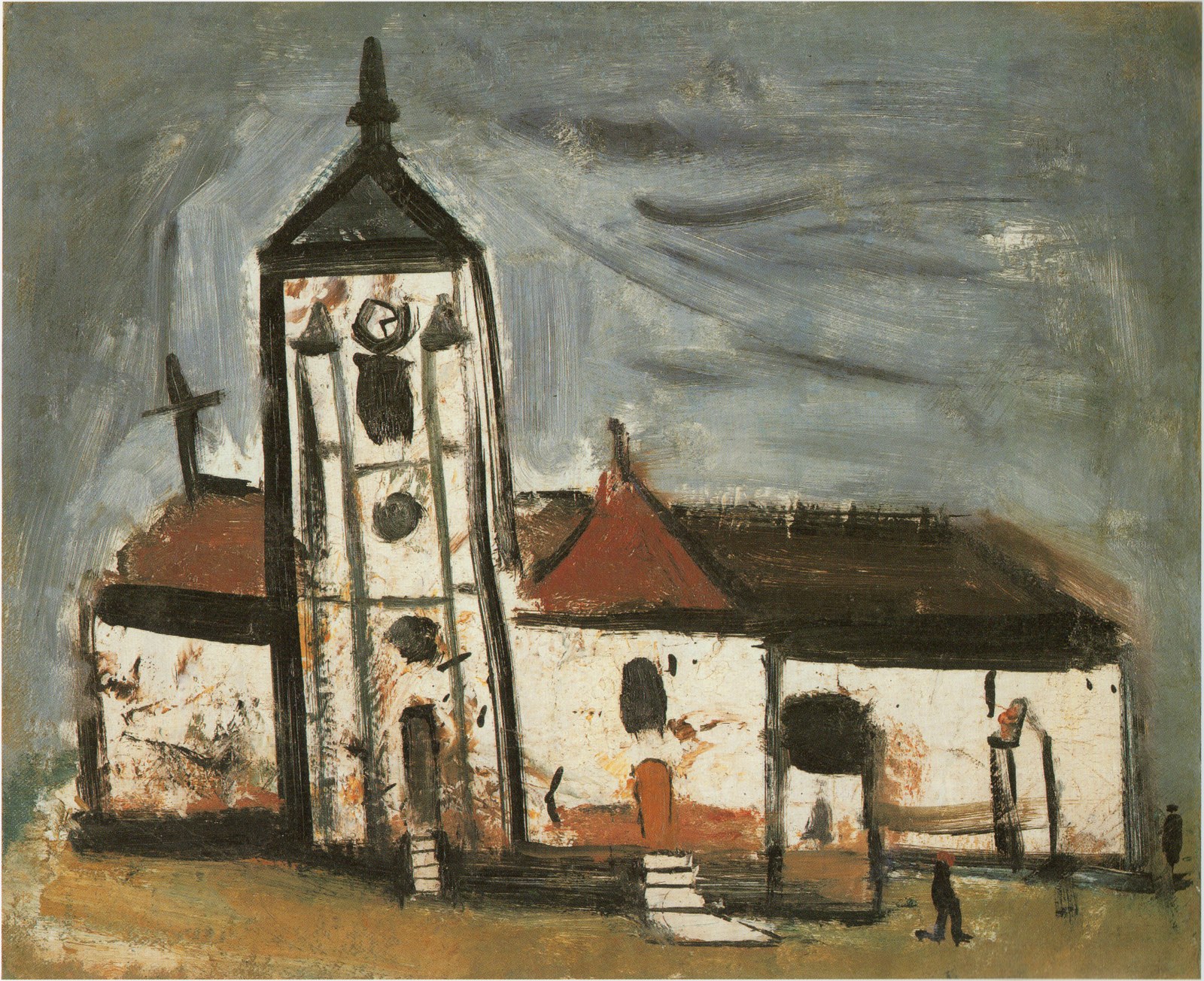
Yuzō Saeki (1898-1928) · 1928 · Oil on canvas · Dimensions not provided
In February 1928, a few months before his death, Yuzō Saeki left Paris for Villiers-sur-Morin accompanied by the Japanese painters Takanori Oguiss and Yamaguchi Takeo. In the winter cold that worsened his tuberculosis, he painted some thirty works in twenty days, seeking in the Brie countryside what he could no longer find in the streets of Paris: a new form, a motif not yet exhausted by the gaze. The village church, with its square tower topped by a slate spire and pierced by a clock, stands at the centre of the composition in a frontal view that recalls the medieval architecture of the Italian primitives. The building takes up almost the full height of the canvas, a compact mass whose yellow ochre walls bear the marks of time: cracks, decay, the wear that makes the religious edifice no longer a symbol of permanence but a fragile witness to the accumulated centuries. On the left, a low annexe, perhaps a porch or a sacristy, leans against the main body; its door, painted a dark red that is almost black, is the only element of intense colour in a palette dominated by the bluish greys of the sky and the muted browns of the roof. The ochre ground stretching across the foreground bears no human trace, no figure, no sign of activity: the church exists in a present emptied of all presence, as if the painter had caught it in a moment outside time.
The handling retains the expressive violence that characterises Saeki’s last Parisian works, but it is modulated differently in the face of religious architecture. The impasto remains thick, applied with the knife in gestures that leave streaks, ridges and roughness in the paint. The sky is not a neutral ground but an active mass, worked in broad sweeps of bluish grey, dirty white and dull blue laid over one another without blending. The clouds do not float: they weigh, they pile up, they turn the atmosphere into a thick substance. The walls of the church, rendered in yellow ochres mixed with grey and white, bear the marks of a construction in successive layers in which colour does not so much cover as add, creating zones of varying density. The brown-red roof, treated in smoother flat areas, contrasts with the roughness of the walls; it catches a diffuse light that comes from no identifiable source. The clock on the tower, a tiny but central detail, shows a time, perhaps three o’clock, that fixes the moment without bringing it to life. This presence of measured time, of time passing mechanically, introduces a disquieting dimension into the composition: time passes, but no one is watching it pass.
For a Japanese artist on French soil, painting a church involves a cultural strangeness that Saeki does not seek to resolve. Trained in a Buddhist tradition, he brings to the Christian edifice neither the piety of the believer nor the distance of the ethnographer, but the gaze of a painter confronted with an architectural form that resists. The church is not a symbol but a volume, a mass that imposes itself on the landscape with a stability that nothing justifies. The windows, reduced to dark openings, reveal nothing of the interior; they function as absences, as holes in the built matter. The red door, the only note of bright colour, promises no access: rather, it marks a closure, an impassable threshold. What is striking about this church is its character as an uninhabited building, as if the faith that had raised it had withdrawn, leaving only the architectural carcass. The contrast between the supposed permanence of religious architecture and the manifest precariousness of the building, its cracked walls, its peeling render, turns the motif into a vanitas: even what was meant to last crumbles, even what carried the promise of eternity submits to wear.
This stay in Villiers-sur-Morin was for Saeki the last attempt to work en plein air before his body betrayed him for good. Back in Paris in March, he began to cough up blood and became bedridden. The canvases painted in the February cold, including this Church of Villiers (Église de Villiers), bear the mark of a physical exhaustion that is transposed into the very substance of the paint: the impasto seems torn out rather than applied, the colour looks heavy, almost laborious. But this laboriousness does not produce ugliness; it generates an intensity that makes every stroke of the knife an affirmation of existence. Saeki died in August 1928 at the age of thirty, taking with him the vision he had begun to build. His daughter Yachiko, aged six, died of tuberculosis two weeks after him.
This Church of Villiers condenses what the rural landscape can hold of irreducible silence in the face of the urban fever that Saeki had been painting a few weeks earlier in the streets of Paris. What the painter fixes here is neither faith nor architecture but the weight of time accumulated in stone, that particular density of buildings that have watched generations pass without taking part. The clock on the tower keeps turning, marking hours that no one comes to consult. The red door stays shut. The sky weighs on the roof. And the painting, by its material presence alone, affirms that there is still something to see, something to fix, even when the body falters and time is counted in days. What can a man paint when he knows that each canvas could be the last?
Marie Gawlikowski & Grégory Mazet, Galerie de Crécy
More about the work Yuzō Saeki The Cercle artistique - creating in a rural setting
 ← Stop 3Rue du Bas Stop 5 →Rue du Touarte