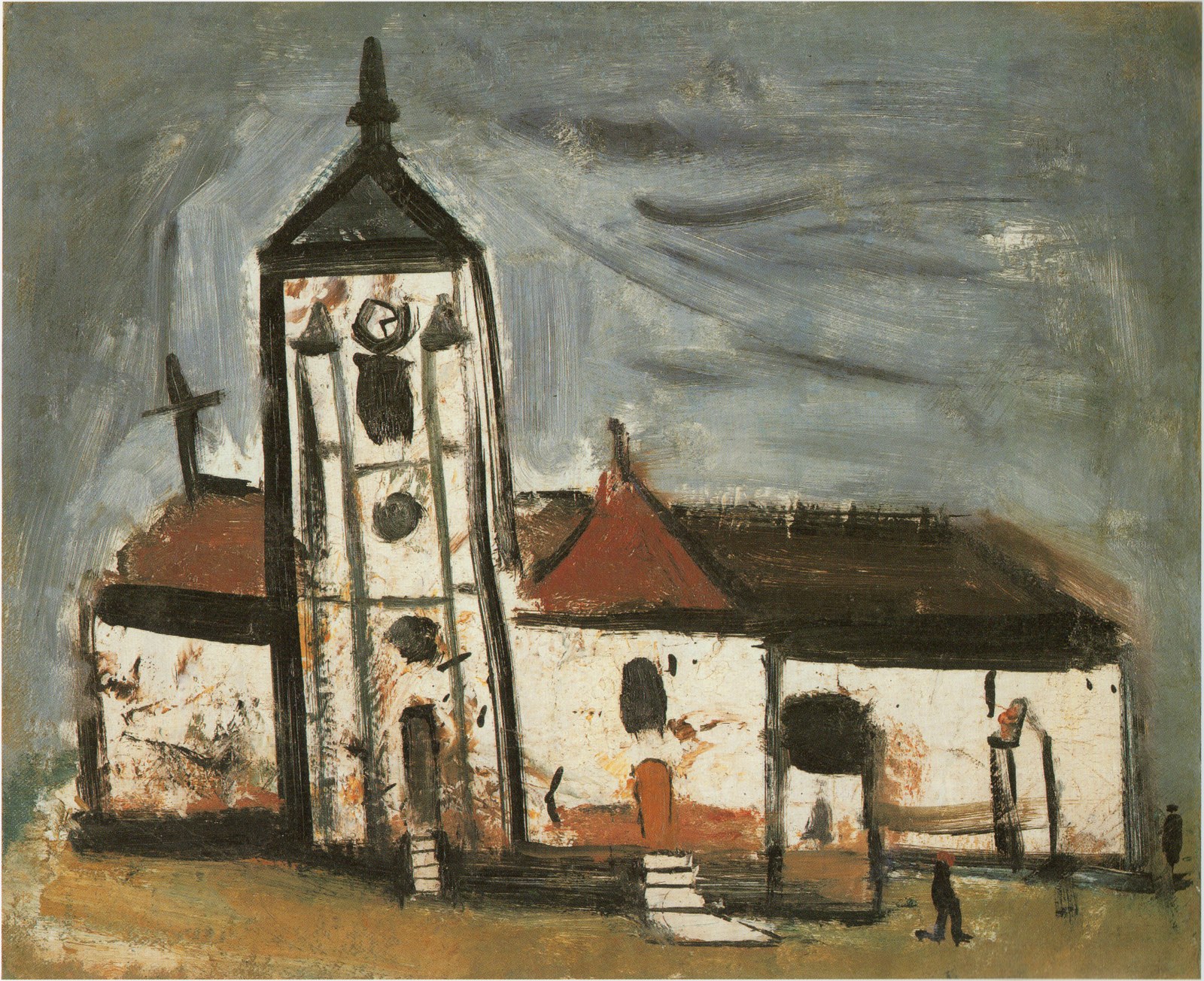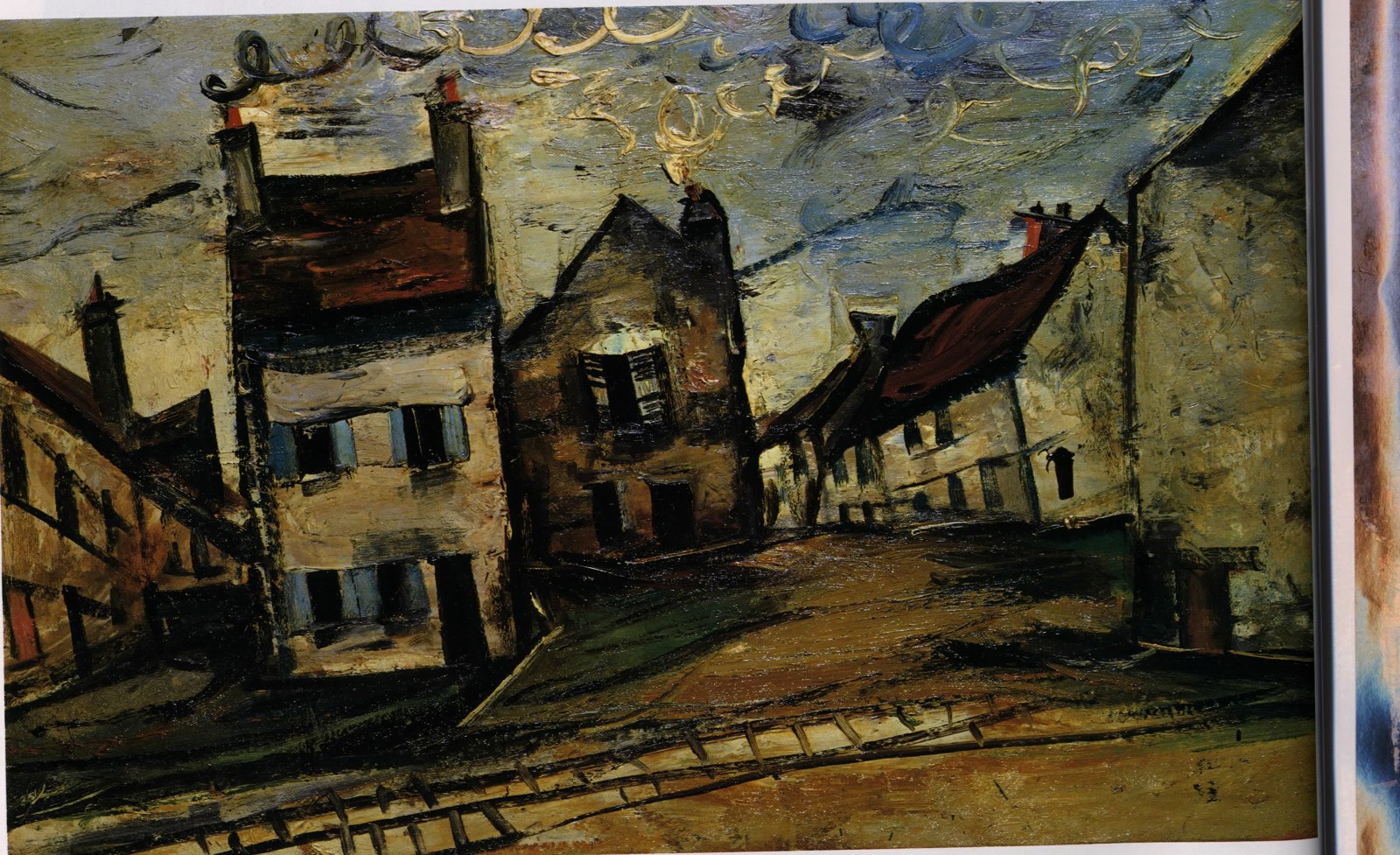
Born in Osaka on 28 April 1898, the son of a Buddhist priest, Yuzō Saeki arrived in France in 1924 after training at the Tokyo School of Fine Arts. Paris absorbed him, consumed him and revealed him. His meeting with Maurice de Vlaminck was decisive: the Fauve of Chatou recognised in him a genuine painterly temperament, shook him up, forced him to call into question everything he knew how to do. Saeki’s style then changed radically: the colour became more violent, the brushstroke heavier, the paint thicker, as if Vlaminck’s criticism had released something that had long been struggling to get out.
By February 1928 the illness had already gained ground, but the painter held out. He left Paris for the Grand Morin valley and spent twenty days at Villiers-sur-Morin, lodging in that district of picturesque, precarious hovels the inhabitants called “the Court of Miracles”. In twenty days, some thirty canvases: The Entrance to Villiers (L’entrée de Villiers), The Town Hall of Villiers (La mairie de Villiers), The Church (L’église), The Court of Miracles (La cour des miracles). Saeki worked as though he knew time was running out, several pictures a day, without losing intensity, in the winter light of the Brie, which he rendered with an urgency that partakes of both genius and premonition.
He died in Paris on 16 August 1928, at the age of thirty, confined to the asylum of Ville-Évrard, to which tuberculosis and exhaustion had led him. His work, held mainly by the Nakanoshima Museum of Art, Osaka, is today regarded as one of the most important in modern Japanese painting. The twenty days at Villiers-sur-Morin are its summit: nowhere else has the brevity of a stay left so lasting an imprint on a territory.
These notes draw on a combination of institutional, documentary and local sources: the artist directory of the Musée d’Orsay; the Centre national des arts plastiques (CNAP); the National Museum of Modern Art, Tokyo (MOMAT); Bénézit, Dictionnaire critique et documentaire des peintres, sculpteurs, dessinateurs et graveurs (Gründ); art market databases (Artprice, Drouot); the catalogues of the Salon des Artistes français and the Salon d’automne; the Satet-Menon collection relating to the painters of the Grand Morin valley; local sources relating to the Vallée des peintres (the commune of Villiers-sur-Morin, Coulommiers Pays de Brie Tourisme); the Museum of Modern Art, New York (Madame Lili Grenier, portrait by Toulouse-Lautrec, 1888); the Nakanoshima Museum of Art, Osaka (work by Yuzō Saeki).