Theme of stop 5
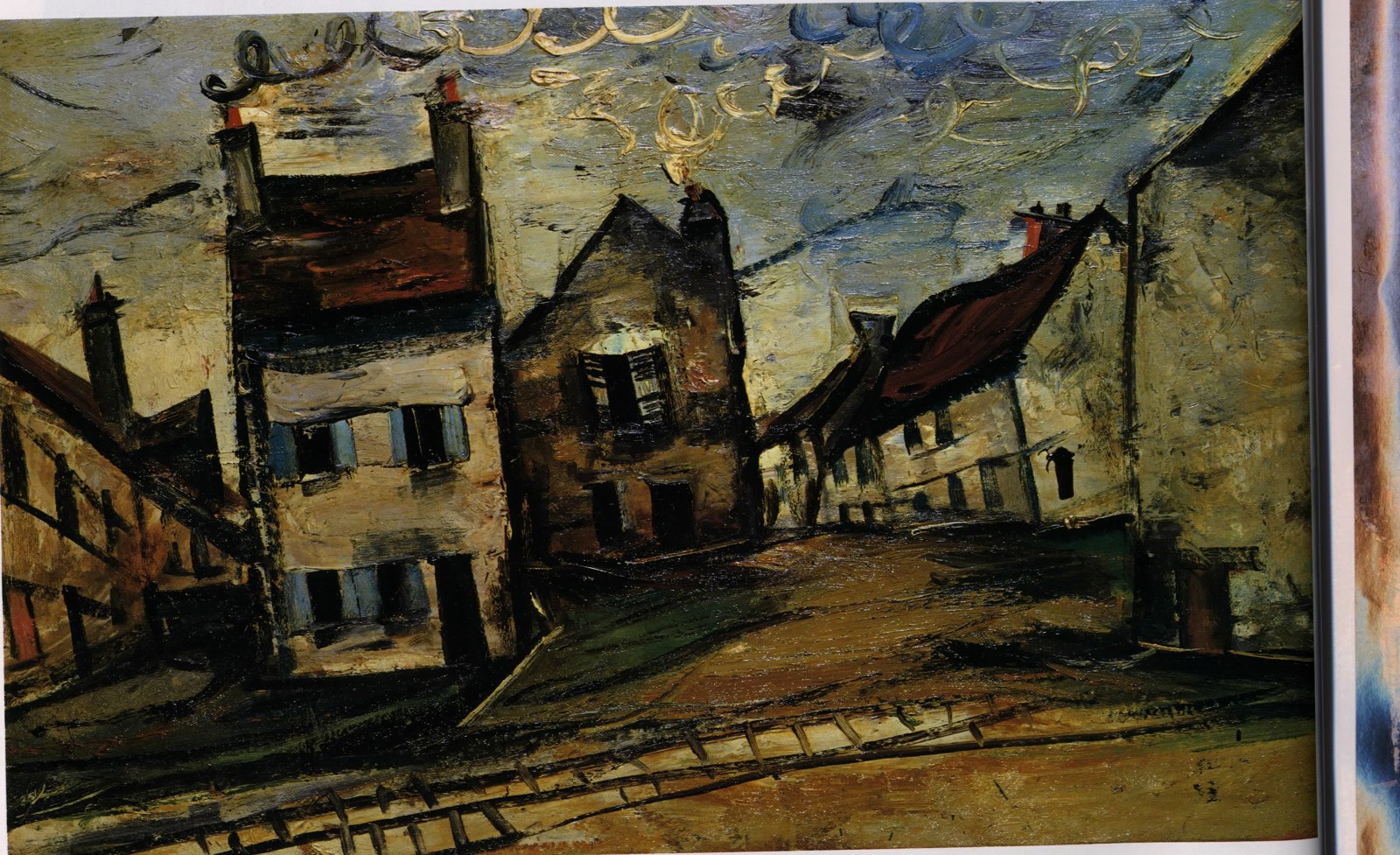
In February 1928, Yuzō Saeki, Takanori Oguiss and Yamaguchi Takeo came to paint in the Grand Morin valley. Their stay is a reminder that dozens of Japanese painters sought in the Île-de-France countryside the motifs of their Western predecessors, and that the Brie colony had an international dimension.
Yuzō Saeki, The Court of Miracles
From Barbizon to Giverny, from Pont-Aven to Collioure, the history of French art has enshrined certain artists’ colonies as “high places” of pictorial modernity; others, though just as active and fruitful, remain in the shadows of historiography. Villiers-sur-Morin belongs to this second category: a village in the Brie, an hour from Paris by the Eastern railway, where dozens of painters followed one another between 1860 and 1928, without this continuous presence ever crystallising into a recognised “school”. How is this erasure to be explained? The answer lies in the very nature of what was practised there: a painting of persistence, attached to vernacular motifs (washhouses, mills, sunken lanes) at a moment when the avant-garde prized rupture.
Amédée Servin (1829-1884), trained in the studio of Michel Martin Drolling and then in that of François Édouard Picot at the École des Beaux-Arts in Paris, counted Jean-Jacques Henner, Benjamin Ulmann and Paul Baudry among his fellow students. In contact with the Barbizon painters, where he crossed paths with Théodore Rousseau and Jean François Millet, he settled in Villiers-sur-Morin c. 1857. There, in 1860, he founded the Cercle artistique, which turned this village in the Grand Morin valley into a welcoming home for Parisian painters. The choice of place was no accident: Corot himself had judged the light of this valley to be “good”. But unlike Barbizon, where Rousseau and Millet imposed a unified vision of the forest landscape, Villiers never produced an aesthetic manifesto, a charismatic guiding figure or an identifiable style.
The artistic output of Villiers is characterised by its heterogeneity. Servin painted workshop interiors in the Dutch tradition; Serrier applied to the Brie landscape the tonal accuracy inherited from Corot; Albert Grenier (1858-1925), a fellow student of Toulouse-Lautrec, Van Gogh and Anquetin at Cormon’s studio, wavered between contemplative seriousness and self-mockery. Louis Anquetin, who developed cloisonnism with Émile Bernard in 1887-1888, was a regular visitor to the Grenier house in Villiers. In February 1928, a few months before his death, the Japanese painter Yuzō Saeki left Paris for Villiers-sur-Morin accompanied by Takanori Oguiss and Yamaguchi Takeo; there he painted some thirty works in twenty days.
The study of this colony reveals less the history of a pictorial movement than the plurality of ways of inhabiting the same territory at different moments. The bridge that Serrier painted in 1888 with Corot-like restraint is no longer the same as the one Saeki would have painted in 1928 with his expressionist violence, not because the bridge had changed, but because the gaze that rested upon it had been transformed.