Stop 6 / 7 · Rue de Paris
A complex and singular relationship with the movement: Servin remained faithful to realism, Serrier adopted a visible brushstroke, Anquetin passed through it before inventing cloisonnism, and Saeki unleashed a violent and personal expression.
In front of the panel of this stop, scan the QR code: the painting reappears in the landscape. The experience needs the panel, it cannot be launched remotely.
Main work
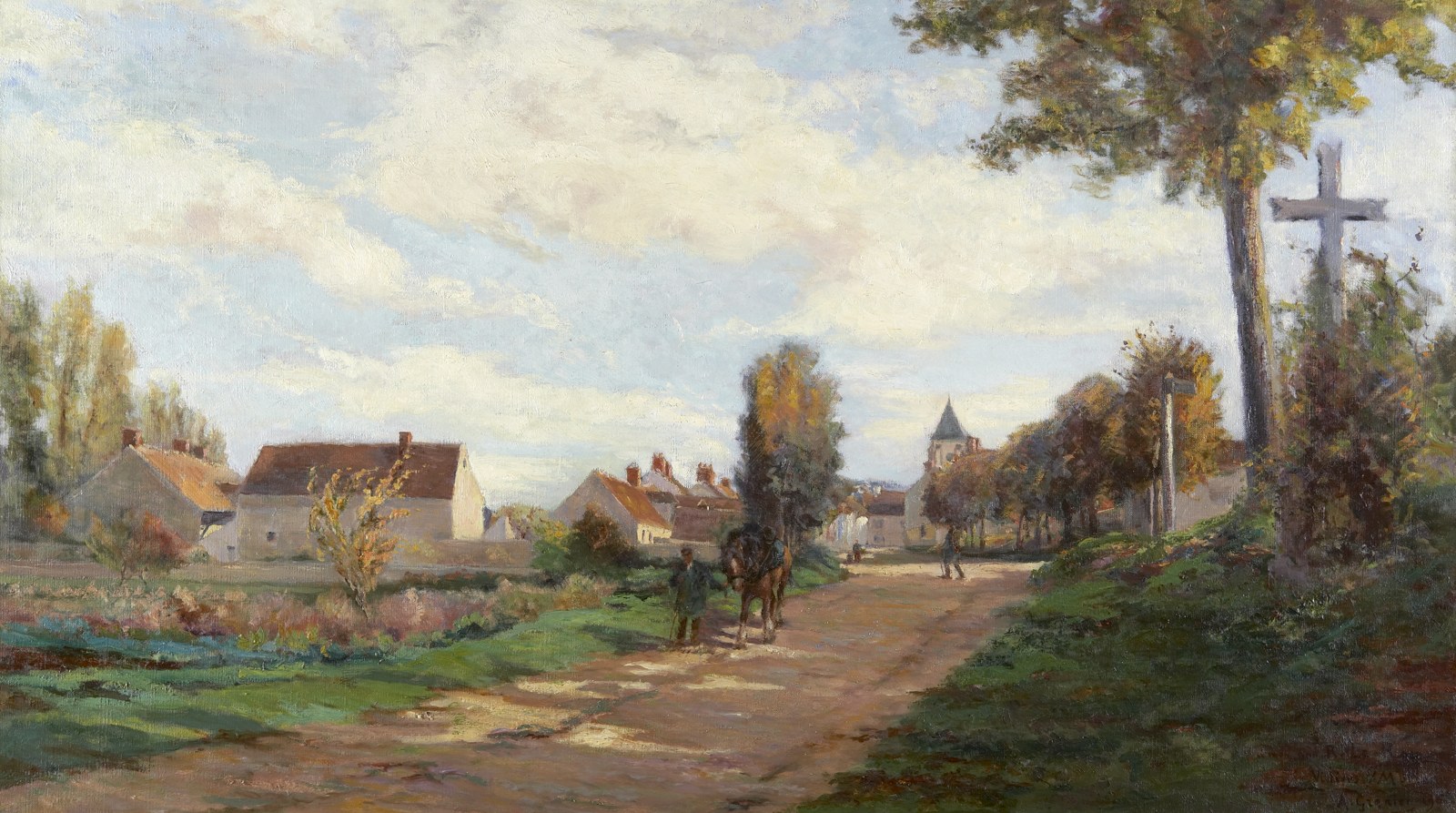
Albert Grenier (1858-1925) · 1900 · Oil on canvas · Dimensions not provided
In 1900, at the turn of the century, Albert Grenier set up his easel before one of the most recurrent motifs in French landscape painting: the country path running off towards the horizon. The white path, cut into the ochre earth and edged with green grass, crosses the composition diagonally from the foreground to the far distance, where the outline of a church tower can be made out. A man leads his horse, or perhaps his donkey, laden and moving slowly along this track linking the hamlet visible on the left, with its red-tiled houses, to the village whose architectural masses can be glimpsed in the distance. On the right, a stone calvary stands at the edge of the path, a simple cross set on a plinth, a marker of popular faith and a landmark for the traveller. Other figures can be made out further along the path, tiny silhouettes absorbed by the depth of the space. The trees framing the scene, on the left a cluster of poplars whose leaves are turning yellow, on the right a darker tree shading the calvary, mark the lateral limits of the visual field while opening up the central perspective. The sky, vast and restless, takes up more than half of the picture surface: swollen white clouds drifting across a pale blue, gaps of light breaking through here and there and casting shifting patches of brightness over the landscape.
The handling reveals the mastery of a painter trained in the principles of naturalist observation but nourished by the contributions of Impressionism. Grenier applies colour in medium-sized touches, neither too blended nor too fragmented, which keep the motif legible while creating an atmospheric vibration. The path itself, painted in light ochres heightened with whites and yellows, catches the overhead light falling from a partly clear sky. The cast shadows, that of the horse and its driver, those of the trees, are not black but coloured, mingling blues, violets and muted greens that testify to an attentive observation of the phenomena of light. The overall palette stays within a register of middle tones: the greens of the meadows, the browns of the roofs, the blues of the sky and the ochres of the path converse without clashing, creating a harmony that evokes gentleness rather than brilliance. The touches that make up the foliage of the trees, small commas of yellow, green and brown accumulating without merging, recall the lesson of Monet or Pissarro, but Grenier applies them with a restraint that preserves the solidity of the volumes. The houses in the background, reduced to a few coloured planes, remain legible without being detailed; they function as spatial markers that anchor the eye in the depth. The calvary, rendered in grey-brown with a few lighter highlights, stands out against the sky without undue drama: it is simply there, a familiar presence in the Brie landscape, part of the everyday scenery.
In the pictorial tradition of the 19th century, the path is never a mere topographical motif. It carries a symbolic dimension that exceeds its practical function: it stands for passage, for circulation, for that possibility of movement which turns a landscape into inhabited territory. The man walking on with his animal embodies the daily life in which work, the carting of harvests or goods, and the comings and goings between hamlets make up the very rhythm of rural existence. The calvary, planted at the edge of the path, introduces another temporality: that of popular faith, which punctuates space with religious signs and turns the land into a sacred geography. These crosses of stone or wood, so characteristic of the French countryside, mark crossroads, village entrances and parish boundaries; they remind the passer-by of the presence of the divine in the most prosaic everyday life. Grenier adopts here a serious, almost contemplative register, in which the landscape is not an object of derision but a subject for pictorial meditation, and this quiet gravity speaks of a suppleness of vision that is confined to no single stance.
To paint a white path in 1900 was to join a lineage going back to Corot, Rousseau and Daubigny, those painters of the Barbizon school who had made the French landscape a noble genre. But it was also to carry on a tradition at a moment when other paths, that of Cézanne, that of the Nabis, and soon that of the Fauves, were already shifting what was at stake in painting. Grenier, who settled permanently in Villiers-sur-Morin at the turn of the century after years of assiduous visits, chose to paint what he saw: the paths, the trees, the houses, the changing sky of the Brie. His practice sought neither radical formal innovation nor the mechanical repetition of academic formulas; it occupied that in-between space where fidelity to the natural motif accommodates the chromatic freedoms learned from the Impressionists. Unlike Saeki, who twenty-eight years later would paint the church of Villiers as a deserted piece of architecture, Grenier depicts a landscape that is inhabited, crossed and used. The path is not empty but travelled. The calvary is not a ruin but a living landmark.
This White Path (Le chemin blanc) condenses a way of inhabiting the landscape that assumes it can still be painted according to the codes inherited from the 19th century without this becoming dead academicism. What Grenier shows us is not a wild nature but a domesticated countryside, organised by human labour and sanctified by the signs of popular faith. The man and his horse move slowly on, at the pace of a world where speed does not yet govern every journey. The calvary stands, discreet but present, a reminder that this landscape is not merely geographical space but territory invested with meaning. And the painting, through its tonal accuracy and its compositional sobriety, affirms that it remains possible to celebrate the modest beauty of an autumn path without grandiloquence or irony. What is left to paint when every path has already been painted, when every calvary has already been depicted?
Marie Gawlikowski & Grégory Mazet, Galerie de Crécy
More about the work Albert Grenier Impressionism in the Brie - seizing the moment
 ← Stop 5Rue du Touarte Stop 7 →Rue de la Picardie