Born at Étrépagny (Eure) on 26 January 1861, Louis Anquetin entered Bonnat’s studio and then moved to Cormon’s, where he met Van Gogh, Bernard, Toulouse-Lautrec and Grenier. It was with Émile Bernard that, around 1887, he developed Cloisonnism, a technique that borrows from Japanese prints and medieval stained glass to outline forms with thick black contours and fill them with flat, pure colours. Félix Fénéon hailed the invention; Gauguin remembered it at Pont-Aven. For a moment, Anquetin seemed to be on the threshold of a pictorial revolution.
But Anquetin quickly turned away from this path to devote himself to the in-depth study of the old masters, Rubens first among them, of whom he became one of the finest exegetes of his generation. This reversal, which disconcerted his contemporaries, reveals less a defeat than a demand: the conviction that an avant-garde without memory condemns itself to lightness, that invention is worth nothing unless it is rooted in knowledge of what came before it. He published several treatises on the technique of the old masters, which remain references for specialists.
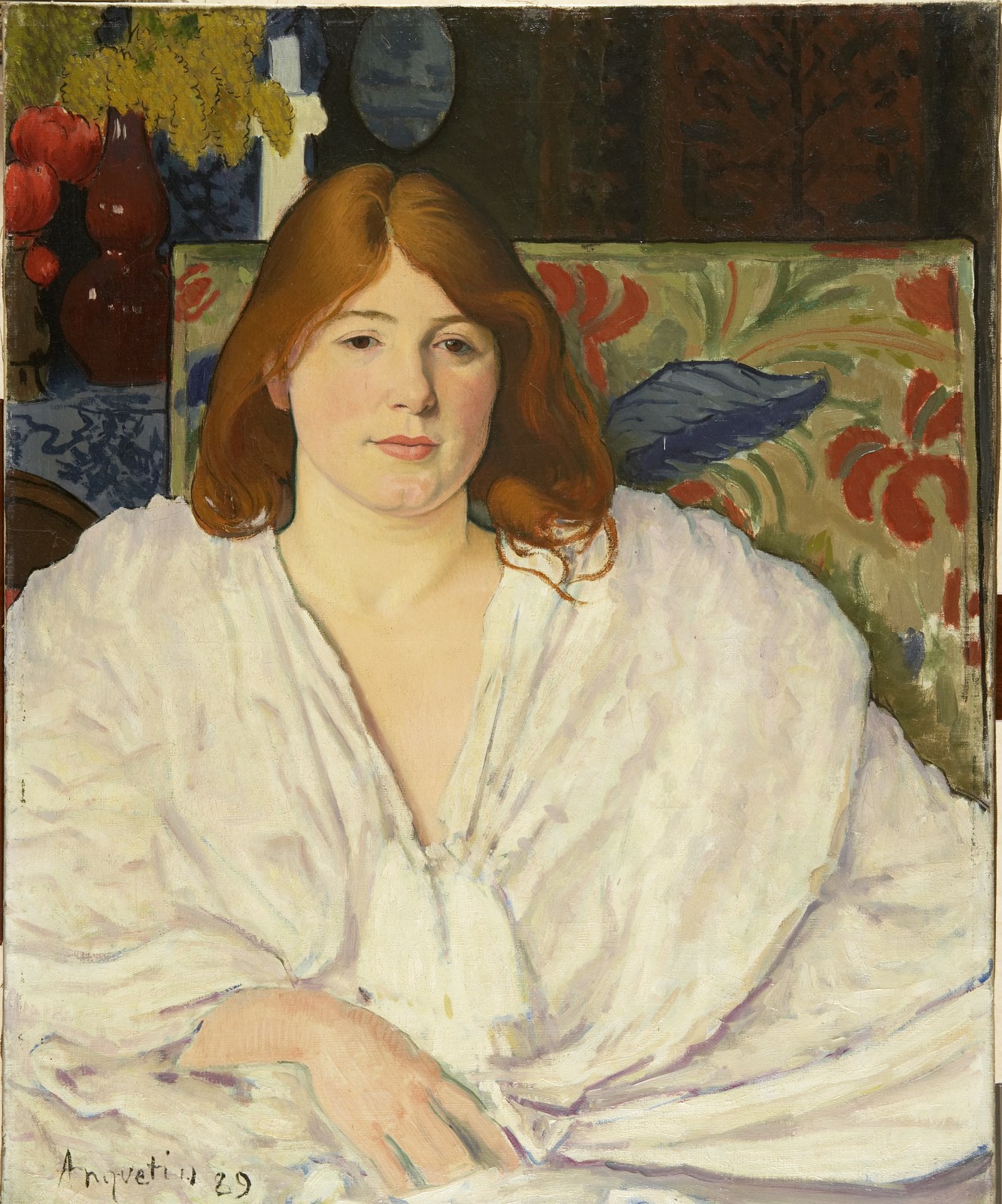
His Portrait of Lili Grenier (Portrait de Lili Grenier), a testimony to the solidity of the friendships formed at Cormon’s studio, bears the mark of the tension peculiar to Anquetin: the chromatic freedom of his Cloisonnist period coexists there with the formal rigour he would never abandon. He died in Paris on 19 August 1932. His work, difficult to classify, halfway between the avant-garde and tradition, still awaits the historian who will do it full justice.
These notes draw on a combination of institutional, documentary and local sources: the artist directory of the Musée d’Orsay; the Centre national des arts plastiques (CNAP); the National Museum of Modern Art, Tokyo (MOMAT); Bénézit, Dictionnaire critique et documentaire des peintres, sculpteurs, dessinateurs et graveurs (Gründ); art market databases (Artprice, Drouot); the catalogues of the Salon des Artistes français and the Salon d’automne; the Satet-Menon collection relating to the painters of the Grand Morin valley; local sources relating to the Vallée des peintres (the commune of Villiers-sur-Morin, Coulommiers Pays de Brie Tourisme); the Museum of Modern Art, New York (Madame Lili Grenier, portrait by Toulouse-Lautrec, 1888); the Nakanoshima Museum of Art, Osaka (work by Yuzō Saeki).