Louis Anquetin (1861-1932) · 1889 · Oil on canvas · 73 × 60 cm · Original title : Portrait de Lili Grenier
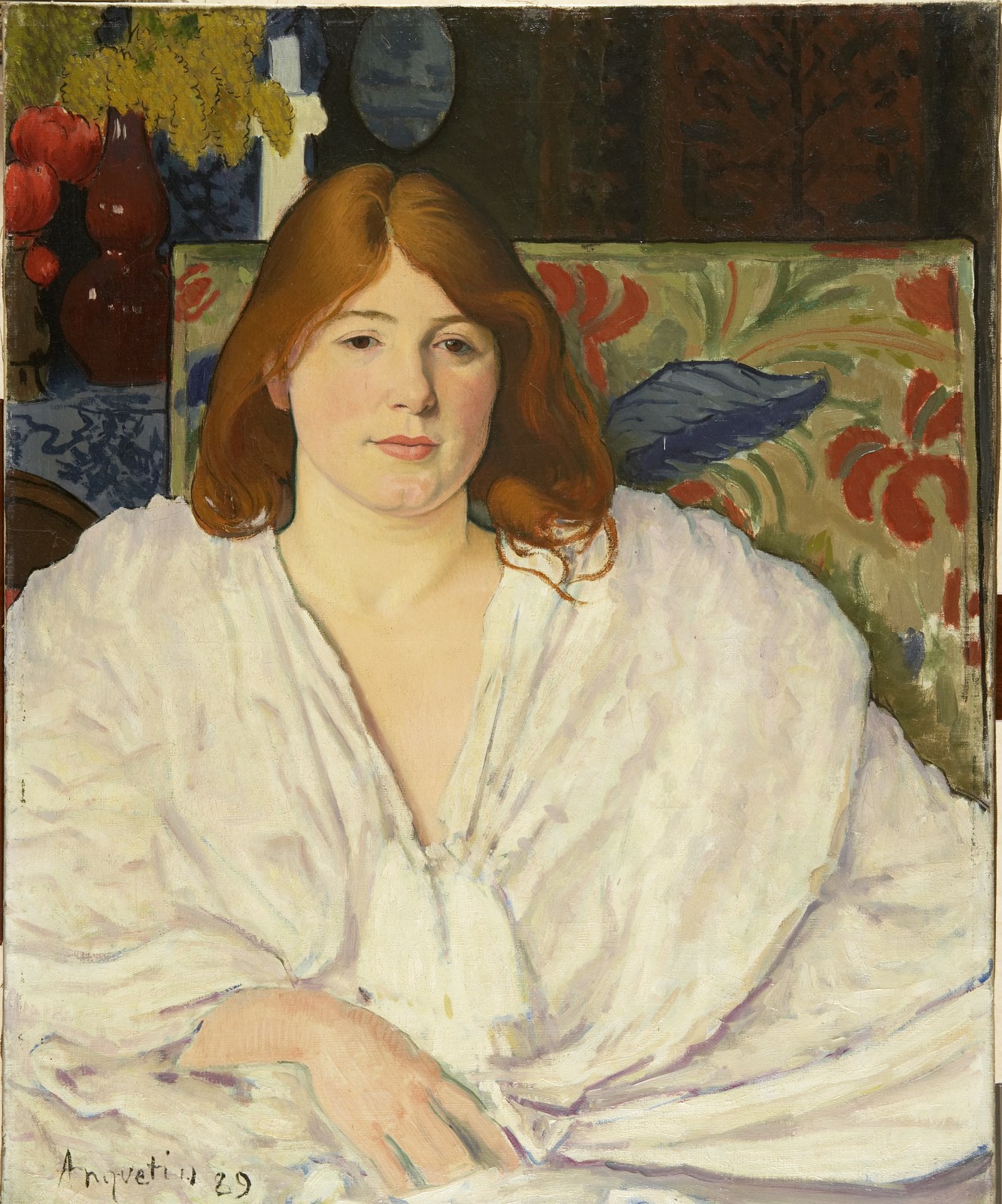
In 1889, the year of the Exposition Universelle that saw the Eiffel Tower rise and consecrated the triumph of industrial modernity, Louis Anquetin painted the portrait of Lili Grenier, the companion, and later wife, of the painter Albert Grenier, in an intimacy that contrasts radically with the official splendours of the capital. The woman depicted occupies almost the full height of the canvas, seated three-quarters on to the viewer, wrapped in a white dressing gown with ample folds whose V-neckline hints at the top of her breast. Her auburn hair, arranged in a soft mass falling to her shoulders, frames a face of regular features in which the hazel-brown gaze fixes on the painter, and by extension on the viewer, with a calm that borders on self-assurance. Her hands, resting one upon the other in the foreground, perform no gesture; they simply rest, in a stillness that makes this woman not a professional model but a familiar presence, caught in domestic intimacy. Behind her, a decorative fabric stretches its flat surface, over which unfold stylised plant motifs, red flowers, green leaves, and a blue bird with outspread wings recalling the Japanese prints with which French artists had been enamoured for two decades. On the left, in the upper corner, a dark jar and a bluish glass object complete a setting that turns the background into an ornamental screen rather than a habitable space.
The handling reveals the rigorous application of the principles of cloisonnism, the pictorial style that Anquetin developed in 1887-1888 alongside Émile Bernard, in reaction against the Impressionist dissolution of form. The contours do not dissolve in atmospheric vibration; they assert themselves through dark outlines that isolate each area of colour, creating a graphic network reminiscent of medieval stained glass or Japanese prints. The face itself, modelled by soft transitions between the pinkish ochre of the cheeks and the pearly white of the forehead, nonetheless retains a certain sensitive roundness that testifies to an attentive observation of living flesh. The hair, treated in broad flat areas of coppery red heightened with lighter touches, shines with a brilliance that has nothing naturalistic about it but functions as a purely decorative quality. The white gown, a true feat of technical bravura, is made up of multiple folds rendered by subtle variations of pearl grey, pure white and very pale blue, which create a play of light and shadow without ever resorting to traditional sculptural modelling. The fabric of the background, with its stylised motifs arranged in decorative symmetry, functions as a flat tapestry that refuses any illusionistic depth. The blue bird, painted in an almost uniform flat tint, stands out against the cream ground like a heraldic emblem. This coexistence of the sitter’s carnal presence and the ornamental flatness of the setting creates a productive tension: the picture hesitates between psychological portrait and decorative panel, between naturalist observation and stylised composition.
To paint Lili Grenier in 1889 was to fix not only the features of a woman but also a particular social position: that of the artist’s wife, an ambiguous figure who takes part in the life of the artists’ colony at Villiers-sur-Morin without occupying the position of creator. Lili is not shown painting, reading or engaged in any activity whatsoever; she is simply there, in a pose that mingles abandon and composure, intimacy and representation. The dressing gown suggests morning or the end of the day, those moments of transition when public appearance relaxes. But the frontality of the pose, the fixity of the gaze and the careful composition of the frame turn this private moment into a public representation. Anquetin, a friend of the Greniers and a regular visitor to Villiers-sur-Morin, chose to portray not Albert, the recognised painter, but Lili, the one who remained in the shadow of the official Salons. This choice is not anecdotal: it reveals the importance of women in the very constitution of these rural artistic circles, their role in creating an environment conducive to creation, their silent but structuring presence in a world where recognition was only rarely granted to them.
Born at Étrépagny in Normandy, trained in the studio of Léon Bonnat and then in Cormon’s studio, where he met Toulouse-Lautrec, Vincent van Gogh and Émile Bernard, Louis Anquetin embodies that generation of artists who, in the 1880s, sought alternative paths to triumphant Impressionism. The cloisonnism he theorised, influenced by Japanese prints and by medieval cloisonné enamels, proposed a synthesis between pure colour and structuring line, between chromatic sensuality and formal rigour. In 1889, Anquetin exhibited at the Café Volpini, alongside Gauguin and Émile Bernard, took part in the Salon des Indépendants and frequented the Mirliton cabaret, where Aristide Bruant sang his realist laments. But unlike Toulouse-Lautrec, who made Parisian nightlife his favoured territory, Anquetin maintained a link with traditional easel painting, with the portrait and the human figure. From the 1890s onwards, he would gradually abandon the boldness of cloisonnism to return to a more academic manner of painting, inspired by Rubens, which earned him the incomprehension of his former avant-garde companions.
This Portrait of Lili Grenier (Portrait de Lili Grenier) condenses a brief but crucial moment in the history of French painting: the moment when cloisonnism, heir to Japonisme and forerunner of Art Nouveau, offered an alternative to both academicism and Impressionism. What Anquetin shows us is not only a woman but a new way of articulating human presence and setting, flesh and ornament, intimacy and stylisation. Lili Grenier, with her calm gaze and relaxed pose, becomes the vehicle for a formal enquiry that goes far beyond the question of the individual portrait. The Japanese-style fabric surrounding her does not function as a mere anecdotal backdrop; it affirms that pictorial modernity is also built by assimilating traditions from outside Europe, by that ability to borrow from ukiyo-e prints their sense of flat colour and line in order to renew the Western gaze. Albert Grenier would go on painting the landscapes of the Grand Morin valley until 1925. But this red-haired face with its tranquil eyes remains, fixed in the cloisonnist certainty of 1889. What remains of a presence when only painting preserves its trace?
Marie Gawlikowski & Grégory Mazet, Galerie de Crécy