The painters
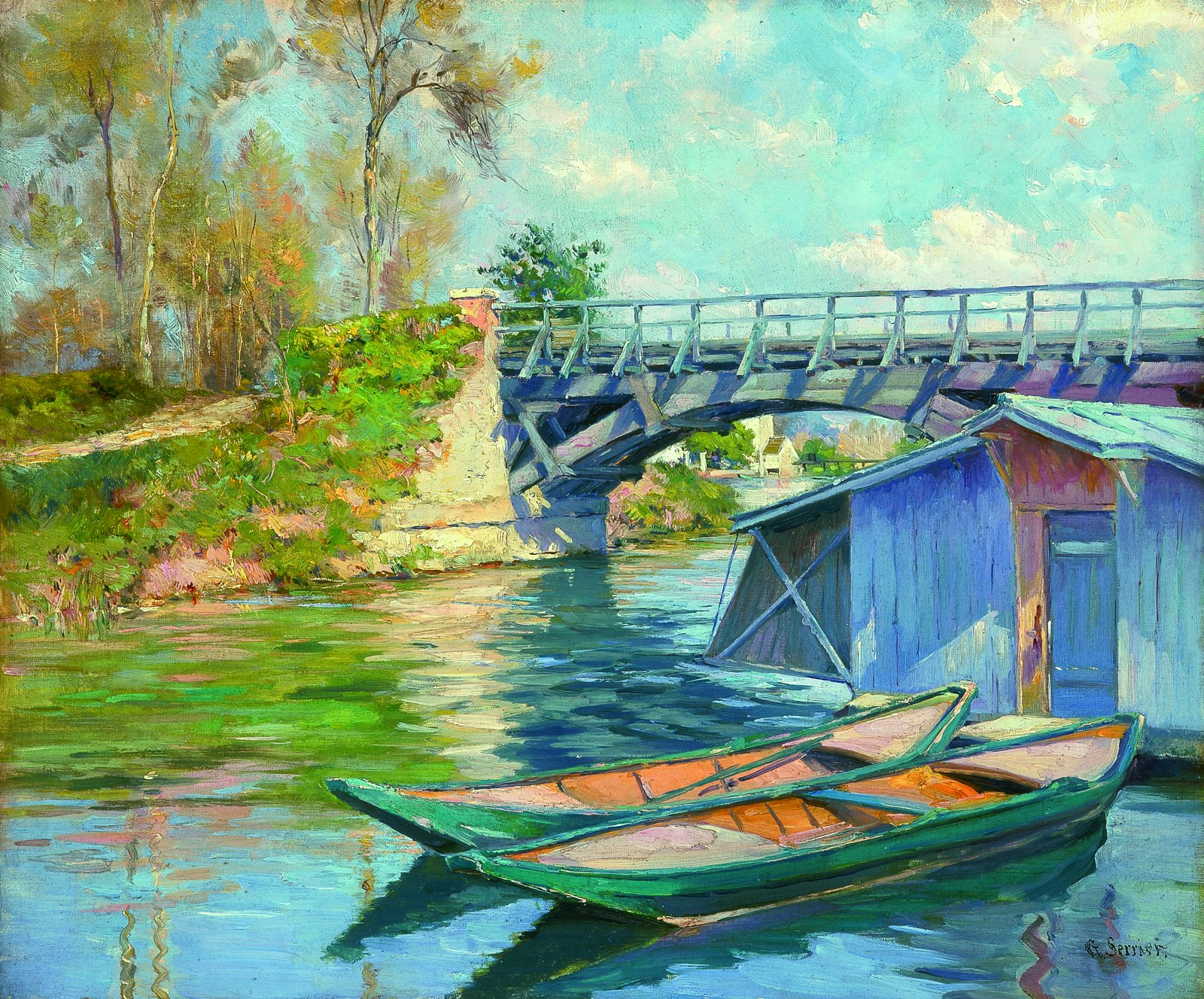
Georges Serrier, The Bridge at Villiers with the Washhouse
Born at Thionville on 10 October 1852, Georges Serrier belongs to that breed of painters whose longevity (he died in 1945, at the age of ninety-two) spans a century of art history without the eye ever yielding to fashion. Trained in the studios of Gagliardini and Oudry, late disciples of the French landscape tradition inherited from Corot, he made his debut at the Salon des Artistes français in 1876 and took part regularly for several decades, a painter of constant fidelity to what is particular about the light of the Île-de-France: its softness without sentimentality, its rightness without brilliance. A civil servant of high culture, deputy head of the Archives department of the Chamber of Deputies, Knight of the Légion d’honneur, Serrier pursued an administrative career and the practice of painting side by side with an ease that betrays not a division of the man but a unified conception of seriousness: the same method, the same rigour, applied to official documents and to canvases alike. This figure of the painter-civil servant, common in 19th-century France, says something essential about the social status of art at the time: an intellectual discipline, not a bohemia. His presence at Villiers-sur-Morin, where he painted in particular The Bridge at Villiers with the Washhouse (Le pont de Villiers avec le lavoir), places him in the circle founded by Amédée Servin, whose attachment to the light of the valley he carried on. His landscapes quietly render what all the painters of the circle sought to capture without ever exhausting it: that quality of atmosphere peculiar to the Grand Morin, that even clarity which envelops forms without dramatising them and makes every ordinary motif, a bridge, a washhouse, moored boats, the occasion for a meditation on the persistence of things.
These notes draw on a combination of institutional, documentary and local sources: the artist directory of the Musée d’Orsay; the Centre national des arts plastiques (CNAP); the National Museum of Modern Art, Tokyo (MOMAT); Bénézit, Dictionnaire critique et documentaire des peintres, sculpteurs, dessinateurs et graveurs (Gründ); art market databases (Artprice, Drouot); the catalogues of the Salon des Artistes français and the Salon d’automne; the Satet-Menon collection relating to the painters of the Grand Morin valley; local sources relating to the Vallée des peintres (the commune of Villiers-sur-Morin, Coulommiers Pays de Brie Tourisme); the Museum of Modern Art, New York (Madame Lili Grenier, portrait by Toulouse-Lautrec, 1888); the Nakanoshima Museum of Art, Osaka (work by Yuzō Saeki).