The painters
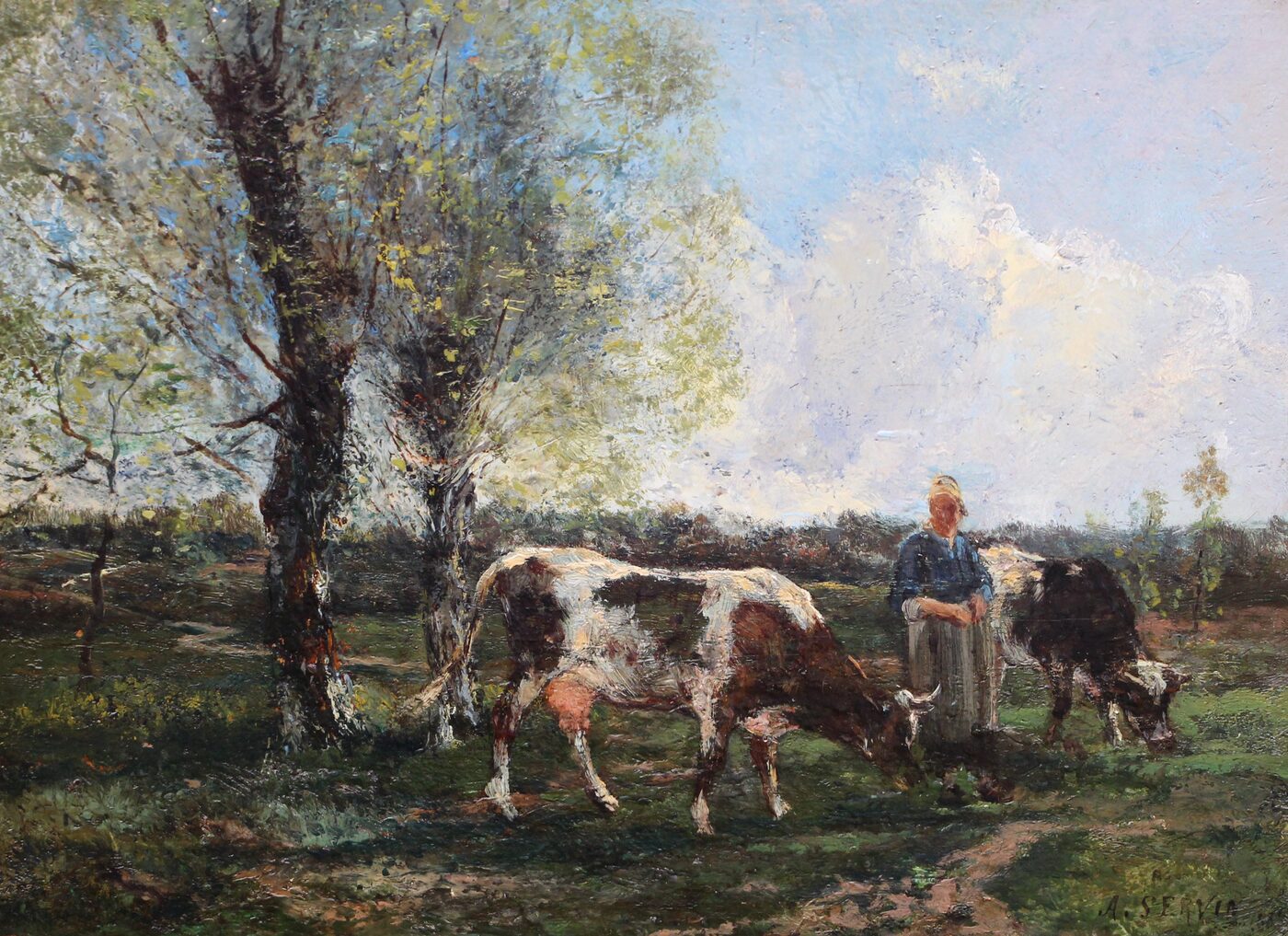
Amédée Servin, Countryside at Villiers-sur-Morin, 1881
Born in Yokohama on 9 December 1891, Kiyoshi Hasegawa arrived in Paris in 1919 and never left it again; naturalised French in 1955, he died in that city in 1980, at the age of eighty-nine, after devoting six decades to mezzotint, a rare and demanding technique that consists in working from black towards light by scraping a copper plate that has first been entirely roughened with a rocker. In his hands, mezzotint was no longer merely a process: it was a philosophy of seeing, the art of going to find brightness at the heart of darkness, of making form emerge from the ground as one draws a living being out of nothingness.
His presence at Voulangis, a village adjoining Villiers-sur-Morin in the Grand Morin valley, reveals an eye attentive to the rural architecture of the Brie in its sobriety and texture, rendered walls, slate roofs, narrow streets that Hasegawa’s framing turns into compositions of a formal rigour close to that of the print. In 1923, the year of his Voulangis watercolour, he acquired the 18th-century intaglio press that Paul Gachet, son of Doctor Gachet, passed on to him, the very press on which Van Gogh had pulled his only etching at Auvers. This biographical detail says something about Hasegawa’s position: heir to a double tradition, Japanese and French, he held a recognised and singular place in the Parisian art world.
An exhibitor at the Salon d’automne, the Salon des Tuileries and the Salon des Indépendants, Hasegawa became one of the world’s masters of mezzotint engraving, his works held in the greatest international public collections. But the watercolours of the Brie bear witness to another side of his work: that of the painter on an excursion, resting his gaze on an ordinary territory with the same patient attention he brought to his copper plate in the studio.
These notes draw on a combination of institutional, documentary and local sources: the artist directory of the Musée d’Orsay; the Centre national des arts plastiques (CNAP); the National Museum of Modern Art, Tokyo (MOMAT); Bénézit, Dictionnaire critique et documentaire des peintres, sculpteurs, dessinateurs et graveurs (Gründ); art market databases (Artprice, Drouot); the catalogues of the Salon des Artistes français and the Salon d’automne; the Satet-Menon collection relating to the painters of the Grand Morin valley; local sources relating to the Vallée des peintres (the commune of Villiers-sur-Morin, Coulommiers Pays de Brie Tourisme); the Museum of Modern Art, New York (Madame Lili Grenier, portrait by Toulouse-Lautrec, 1888); the Nakanoshima Museum of Art, Osaka (work by Yuzō Saeki).