The painters
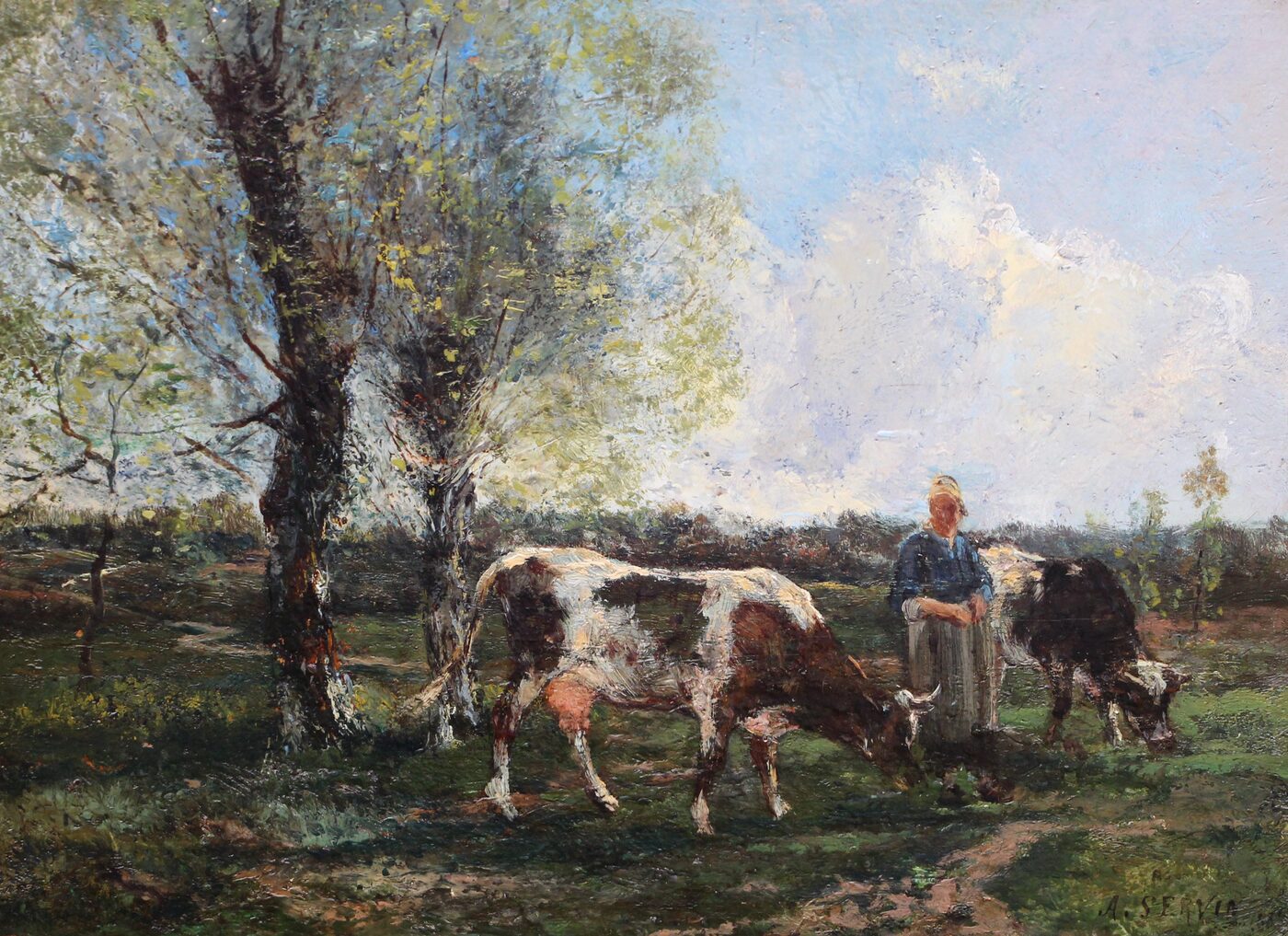
Amédée Servin, Countryside at Villiers-sur-Morin, 1881
Henri Ostolle Delage belongs to that category of artists of whom art history has lost track, not because they never existed, but because collective memory, for want of narratives and institutional consecration, leaves in the shadows those who did not seek to impose themselves. His biography remains, to date, fragmentary. His presence at Villiers-sur-Morin is attested by several canvases depicting the village and its surroundings, The Entrance to Villiers (L’entrée de Villiers), The Church Square (La place de l’église), The Farmyard at Villiers-sur-Morin (La cour de ferme à Villiers-sur-Morin), works that reveal an observer attentive to the real topography of the place, concerned to render the volumes and the light of a modest rural architecture without seeking to embellish it.
This documentary concern, which does not exclude genuine sensibility, makes his canvases precious sources for our knowledge of how the village looked in the late 19th century: in them one reads the arrangement of the houses, the materiality of the facades, the organisation of public space around the church, information that no written archive restores with the same visual evidence. Ostolle Delage did not seek to interpret the territory; he looked at it, and that patient, faithful gaze constitutes in its own way a rare form of fidelity.
He belongs to those painters without whom the history of an artists’ colony cannot be fully written, those who are neither leaders of a school nor innovators, but who give a place its depth by looking at it with constancy. That his work at Villiers-sur-Morin deserves to be better known is what each of his canvases says to anyone willing to look at them properly.
These notes draw on a combination of institutional, documentary and local sources: the artist directory of the Musée d’Orsay; the Centre national des arts plastiques (CNAP); the National Museum of Modern Art, Tokyo (MOMAT); Bénézit, Dictionnaire critique et documentaire des peintres, sculpteurs, dessinateurs et graveurs (Gründ); art market databases (Artprice, Drouot); the catalogues of the Salon des Artistes français and the Salon d’automne; the Satet-Menon collection relating to the painters of the Grand Morin valley; local sources relating to the Vallée des peintres (the commune of Villiers-sur-Morin, Coulommiers Pays de Brie Tourisme); the Museum of Modern Art, New York (Madame Lili Grenier, portrait by Toulouse-Lautrec, 1888); the Nakanoshima Museum of Art, Osaka (work by Yuzō Saeki).