The painters
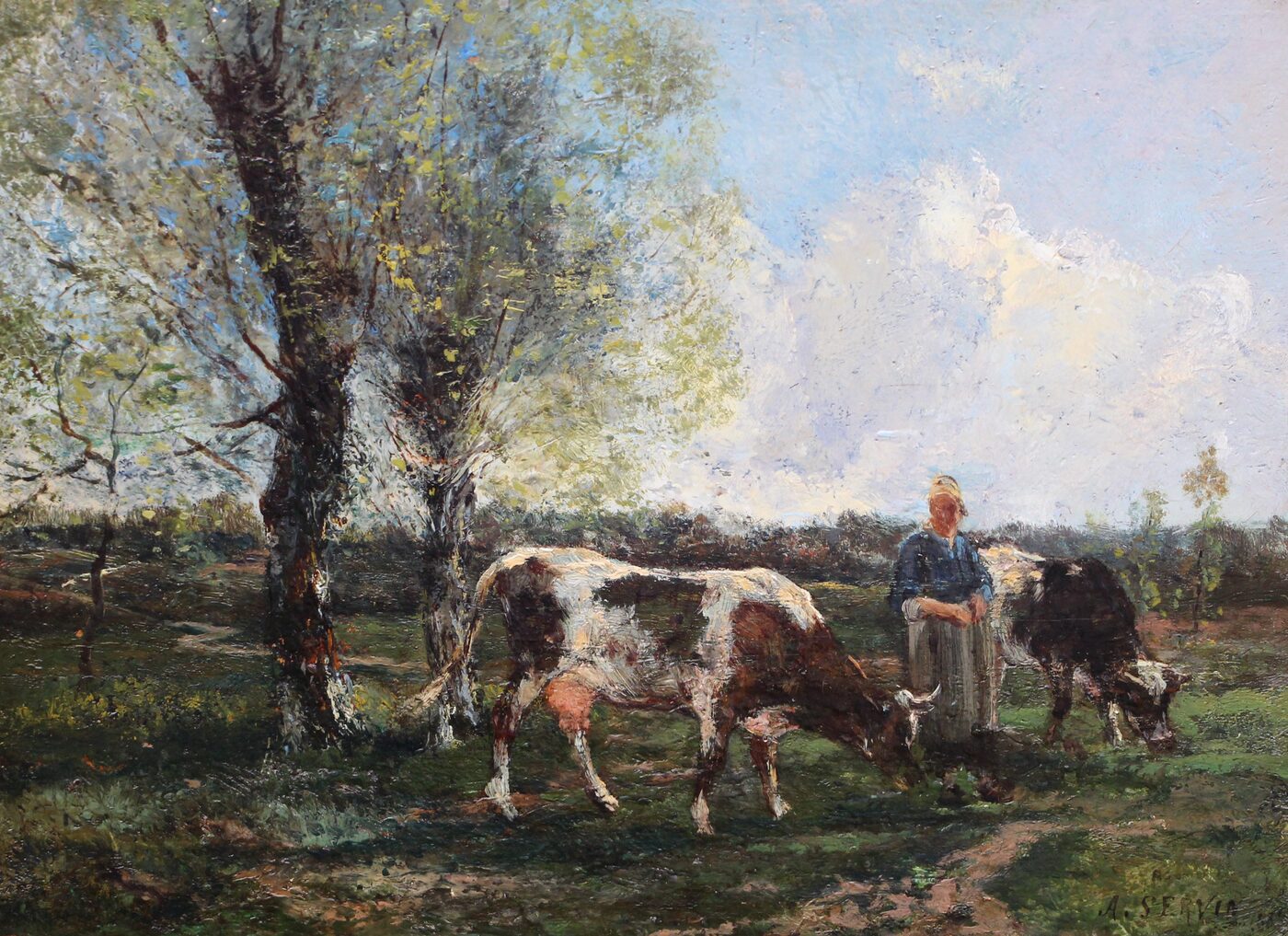
Amédée Servin, Countryside at Villiers-sur-Morin, 1881
Born on 7 September 1897 at Allamps (Meurthe-et-Moselle), Georges Rault belongs to that generation of painters whom the Great War passed right through before they found their territorial anchorage. Living near Villiers-sur-Morin, he settled in the hamlet of Montaigu, where some of the painters who had chosen to remain faithful to the valley gathered in the post-war years: Menon, Foulet, Simon, Serveau and Rault himself formed this discreet circle, without programme or manifesto, bound simply by proximity and the shared practice of painting in the same landscape.
General secretary of the professional painters’ union in the 1930s, politically engaged, a resident of the Cité Montmartre aux Artistes on rue Ordener, Rault is a singular figure in the Villiers circle: a painter of the social world as much as an artist of the motif, author of Evening of Riot (Soir d’émeute), purchased by the City of Paris, and of several views held by the Centre national des arts plastiques, Rue de l’abreuvoir, Place du Tertre, Coutevroult, Evening Landscape (Coutevroult, paysage du soir). His work The Court of Miracles (La cour des miracles), a title that takes up the popular name the inhabitants of Villiers gave to the district of hovels at the bottom of the village, the same one Saeki had painted in 1928, speaks of the continuity of a gaze on the margins of the village, on those precarious, living spaces that official painting would not have deemed worthy of interest. Rault died in 1977, having watched the village change without ever ceasing to paint it.
These notes draw on a combination of institutional, documentary and local sources: the artist directory of the Musée d’Orsay; the Centre national des arts plastiques (CNAP); the National Museum of Modern Art, Tokyo (MOMAT); Bénézit, Dictionnaire critique et documentaire des peintres, sculpteurs, dessinateurs et graveurs (Gründ); art market databases (Artprice, Drouot); the catalogues of the Salon des Artistes français and the Salon d’automne; the Satet-Menon collection relating to the painters of the Grand Morin valley; local sources relating to the Vallée des peintres (the commune of Villiers-sur-Morin, Coulommiers Pays de Brie Tourisme); the Museum of Modern Art, New York (Madame Lili Grenier, portrait by Toulouse-Lautrec, 1888); the Nakanoshima Museum of Art, Osaka (work by Yuzō Saeki).