The painters
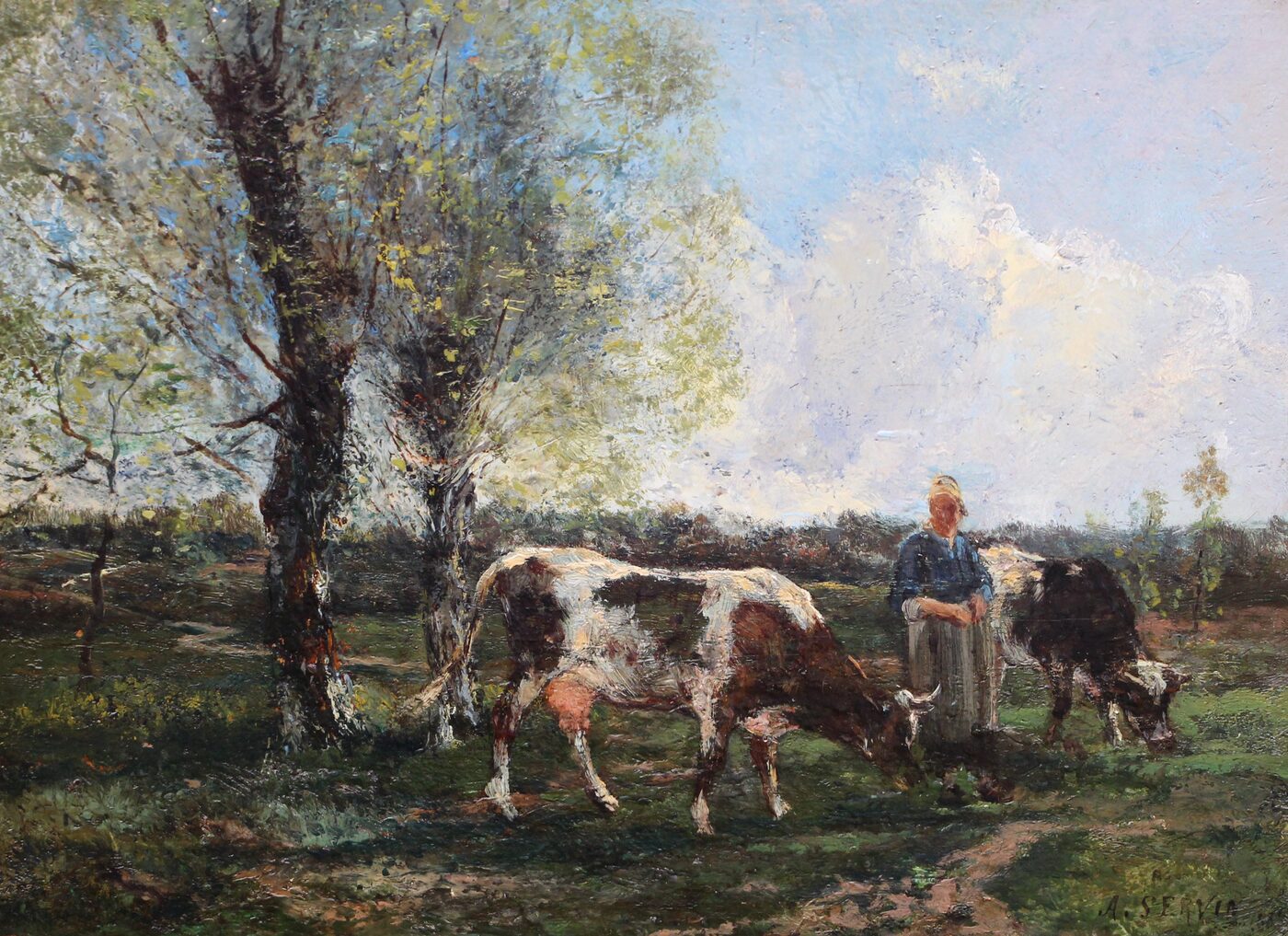
Amédée Servin, Countryside at Villiers-sur-Morin, 1881
Born in 1863, Émile-René Ottoz was the son of Jérôme Ottoz, a Parisian colour merchant whose name appears on several 19th-century canvases, and of whom Degas himself painted a portrait, a discreet inscription of this supplier in the memory of art. This family background, at the crossroads of trade and artistic practice, nurtured in Ottoz a dual competence as painter and picture restorer, activities he pursued together throughout a career attested in art market databases and in several private collections.
The Mill of La Sault on the Grand Morin (Le moulin de la Sault sur le Grand Morin), dated 1900 and held in the corpus of the Galerie de Crécy, places Ottoz in the long pictorial tradition of the painters of Brie mills: a functional building at the water’s edge, a place where human labour and natural forces have been negotiating their coexistence for centuries. The wheel, the millrace, the reflections of the river on the stone, motifs that several painters of the circle took up before and after him, find in Ottoz a rendering that speaks of attachment to this territory in what is most alive about it. He died in 1934, having crossed the turn of the century with the constancy of one who knows what he is looking for in a landscape.
These notes draw on a combination of institutional, documentary and local sources: the artist directory of the Musée d’Orsay; the Centre national des arts plastiques (CNAP); the National Museum of Modern Art, Tokyo (MOMAT); Bénézit, Dictionnaire critique et documentaire des peintres, sculpteurs, dessinateurs et graveurs (Gründ); art market databases (Artprice, Drouot); the catalogues of the Salon des Artistes français and the Salon d’automne; the Satet-Menon collection relating to the painters of the Grand Morin valley; local sources relating to the Vallée des peintres (the commune of Villiers-sur-Morin, Coulommiers Pays de Brie Tourisme); the Museum of Modern Art, New York (Madame Lili Grenier, portrait by Toulouse-Lautrec, 1888); the Nakanoshima Museum of Art, Osaka (work by Yuzō Saeki).