The painters
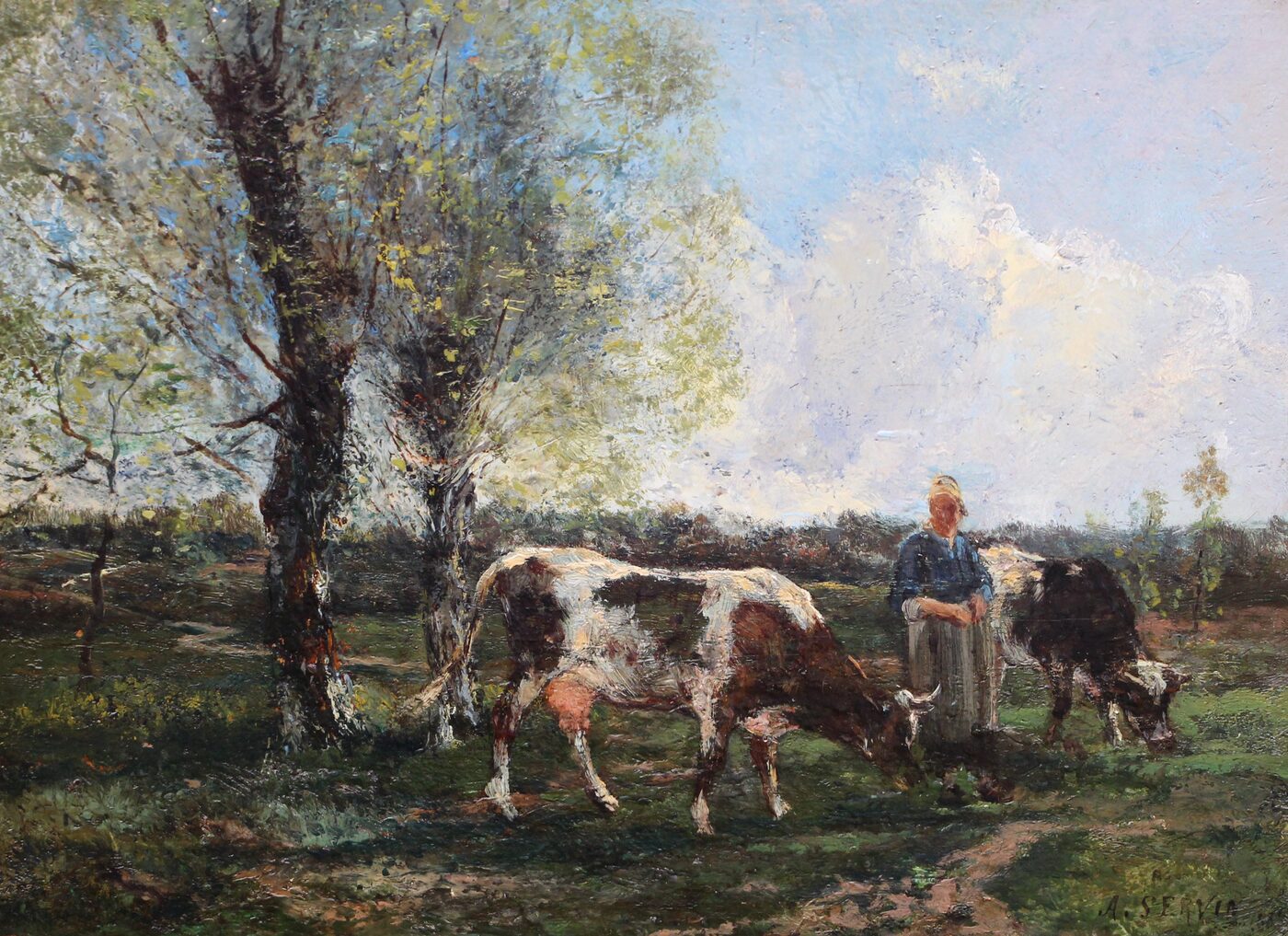
Amédée Servin, Countryside at Villiers-sur-Morin, 1881
Born in 1866, Émile-Louis Méret trained under Jules Lefebvre and Tony Robert-Fleury, two masters of the French academic tradition whose studios welcomed, in the 1880s and 1890s, an entire generation of painters devoted to the Salon. Active between the late 19th century and the 1920s, he is recognised by the Musée d’Orsay directory, which devotes a documentary entry to him. Méret belongs to those serious practitioners whom posterity has remembered less consistently than their masters, but whose regularity and rigour testify to a genuine vocation.
The work Villiers-sur-Morin, which represents him in the corpus, carries within itself his most direct biography: a painter trained in the Parisian academic tradition chose to rest his gaze on this Brie village, to fix on canvas what the valley offered to his eye, with the care reserved for things that deserve to be remembered. He died in 1939, at the end of a long painter’s life that had passed through the upheaval of Impressionism, the avant-gardes of the early century and two wars, without his attachment to the truth of the motif ever wavering.
These notes draw on a combination of institutional, documentary and local sources: the artist directory of the Musée d’Orsay; the Centre national des arts plastiques (CNAP); the National Museum of Modern Art, Tokyo (MOMAT); Bénézit, Dictionnaire critique et documentaire des peintres, sculpteurs, dessinateurs et graveurs (Gründ); art market databases (Artprice, Drouot); the catalogues of the Salon des Artistes français and the Salon d’automne; the Satet-Menon collection relating to the painters of the Grand Morin valley; local sources relating to the Vallée des peintres (the commune of Villiers-sur-Morin, Coulommiers Pays de Brie Tourisme); the Museum of Modern Art, New York (Madame Lili Grenier, portrait by Toulouse-Lautrec, 1888); the Nakanoshima Museum of Art, Osaka (work by Yuzō Saeki).