The painters
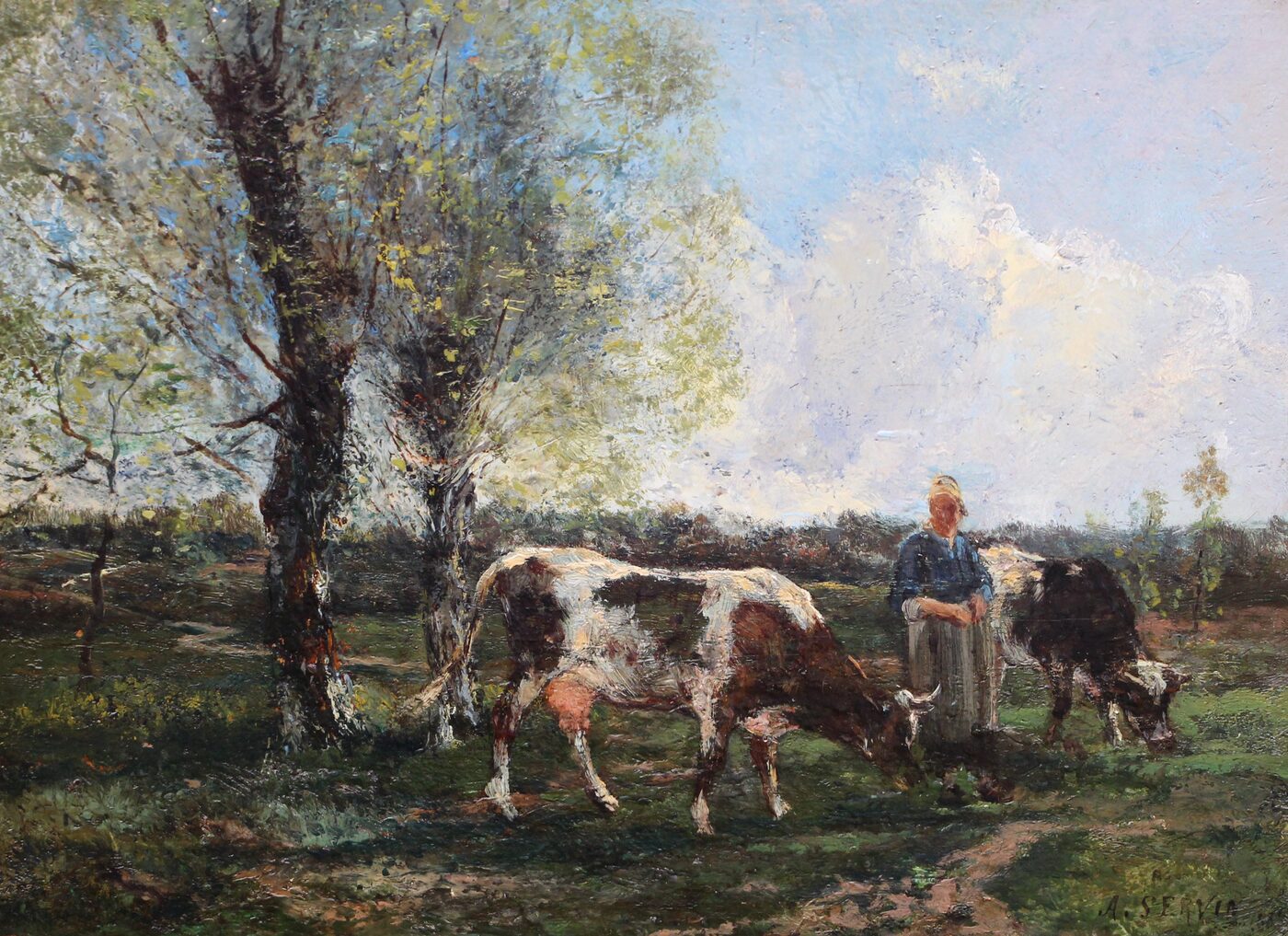
Amédée Servin, Countryside at Villiers-sur-Morin, 1881
Born in Paris on 29 June 1886, Henri Clément Serveau, known as Clément-Serveau, trained at the École nationale des Arts décoratifs and then in the studios of Raphaël Collin and Luc-Olivier Merson at the École des Beaux-Arts. Poster artist, illustrator, watercolourist and painter, he developed a graphic style of great elegance that quickly earned him a place in the worlds of illustration and publishing: his posters for the railways, his illustrations for the major magazines of the interwar years, and his postage stamps, which circulated his images in millions of copies, made him one of the characteristic figures of French graphic art in the first half of the 20th century.
His presence at Villiers-sur-Morin, attested by the canvas Villiers and Its Church (Villiers et son église), bears witness to the enduring attraction the village continued to exert on Parisian artists well beyond the founding generation. For an artist trained in the reproducible image, in drawing that must be legible at speed and on a large scale, the choice to paint the church of Villiers in an intimate format is significant: it is the painter reclaiming his rights over the graphic designer, slowing down, looking, seeking in the village motif what the poster cannot contain.
Knight of the Légion d’honneur, member of the Salon des Artistes français and the Salon d’automne, Clément Serveau died in Paris on 5 December 1972. His graphic work, of constant diversity and quality, illustrates the vitality of the image arts in 20th-century France. The Villiers-sur-Morin canvas is its discreet counterpoint, the share of intimacy that every great artist of the public image ends up claiming.
These notes draw on a combination of institutional, documentary and local sources: the artist directory of the Musée d’Orsay; the Centre national des arts plastiques (CNAP); the National Museum of Modern Art, Tokyo (MOMAT); Bénézit, Dictionnaire critique et documentaire des peintres, sculpteurs, dessinateurs et graveurs (Gründ); art market databases (Artprice, Drouot); the catalogues of the Salon des Artistes français and the Salon d’automne; the Satet-Menon collection relating to the painters of the Grand Morin valley; local sources relating to the Vallée des peintres (the commune of Villiers-sur-Morin, Coulommiers Pays de Brie Tourisme); the Museum of Modern Art, New York (Madame Lili Grenier, portrait by Toulouse-Lautrec, 1888); the Nakanoshima Museum of Art, Osaka (work by Yuzō Saeki).