The painters
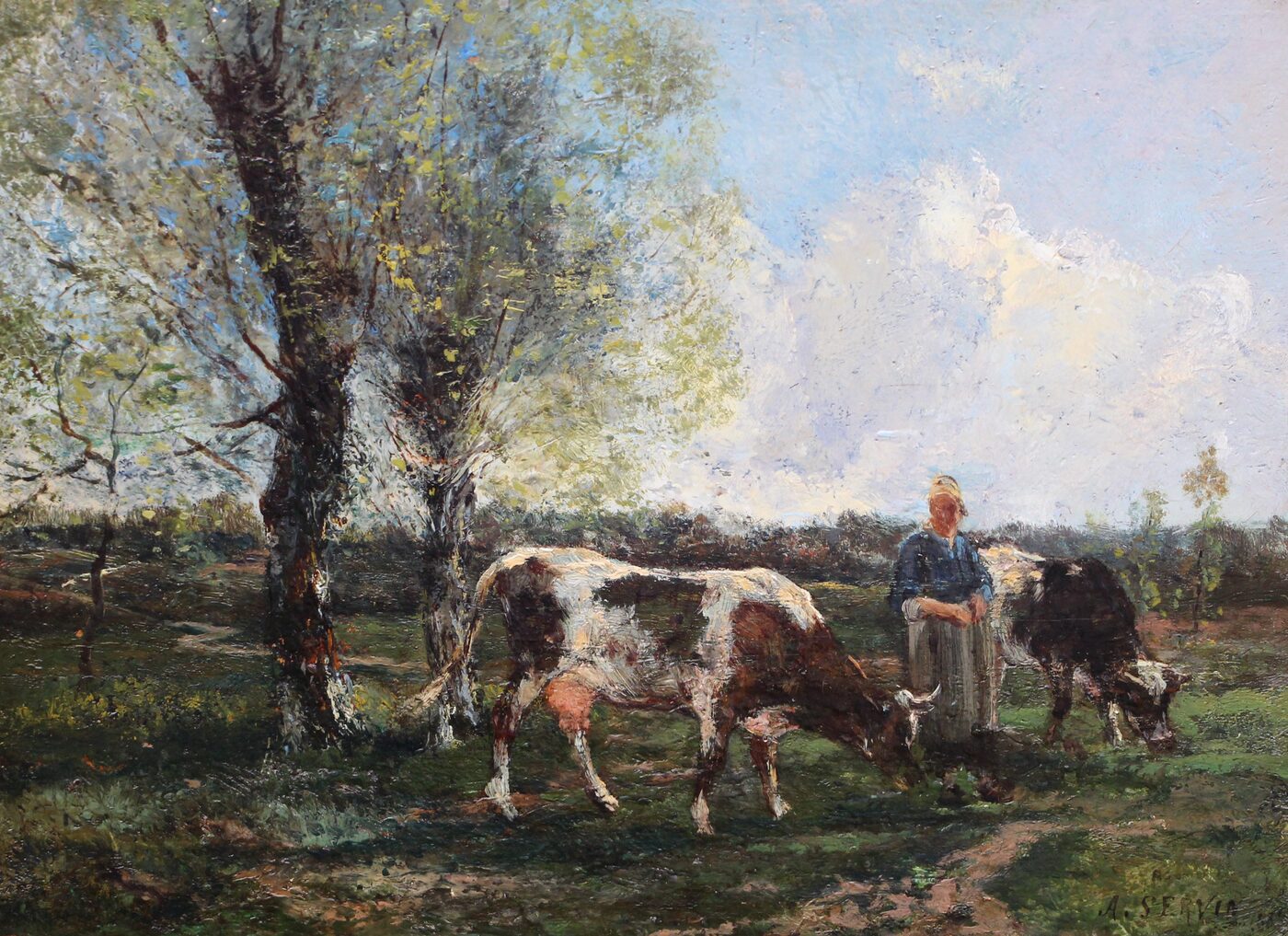
Amédée Servin, Countryside at Villiers-sur-Morin, 1881
Born in Paris on 16 July 1796 into a family of prosperous merchants, Jean-Baptiste-Camille Corot received in 1822 his family’s permission to take up a career as a painter, together with an allowance that would enable him to work free of economic constraint until the death of his parents. He stayed three times in Italy, travelled tirelessly across France, and set up his easel wherever the light seemed right to him, in Fontainebleau as in Normandy, in the Morvan as in Provence. Long regarded as an amateur, he was not fully recognised until after 1850; but this late recognition never embittered him. Corot was one of those men for whom painting is not a career but a way of inhabiting the world, and the world, for him, always began with the light of dawn on wet leaves.
It was in 1873, one of the last summers of his life, that Corot stayed at Crécy-en-Brie, at 32 rue Dam’Gilles, with his friend Francisque Chatelain, a local painter who, with Cinot, was one of his two principal pupils, both of them formed in the love of the Brie countryside. He painted several canvases in the surroundings of Crécy, including a view of the Pré Manche at Voulangis, which can be precisely located in the landscape today. The Robaut catalogue, the exhaustive reference for his work, documents these final painting campaigns with the rigour that a body of work of this scale demands.
Corot died in Paris on 22 February 1875. His stay at Crécy in 1873 was not an epilogue but a confirmation: all his life he had sought in the ordinary landscapes of France, plains, rivers, forest edges, the same quality of light that the Brie gave him so naturally. That the Grand Morin valley was one of his last territories says something about what is fundamental in this landscape: not spectacle, but the quiet presence of things in their own light.
These notes draw on a combination of institutional, documentary and local sources: the artist directory of the Musée d’Orsay; the Centre national des arts plastiques (CNAP); the National Museum of Modern Art, Tokyo (MOMAT); Bénézit, Dictionnaire critique et documentaire des peintres, sculpteurs, dessinateurs et graveurs (Gründ); art market databases (Artprice, Drouot); the catalogues of the Salon des Artistes français and the Salon d’automne; the Satet-Menon collection relating to the painters of the Grand Morin valley; local sources relating to the Vallée des peintres (the commune of Villiers-sur-Morin, Coulommiers Pays de Brie Tourisme); the Museum of Modern Art, New York (Madame Lili Grenier, portrait by Toulouse-Lautrec, 1888); the Nakanoshima Museum of Art, Osaka (work by Yuzō Saeki).